
Eroding Public Trust and Constitutional Faith
India’s judiciary has long been regarded as the last refuge of constitutional morality. For decades, citizens and international investors alike have trusted Indian courts not because of governments or bureaucracies, but because judges were seen as independent arbiters insulated from political and ideological capture. That trust is now being tested.
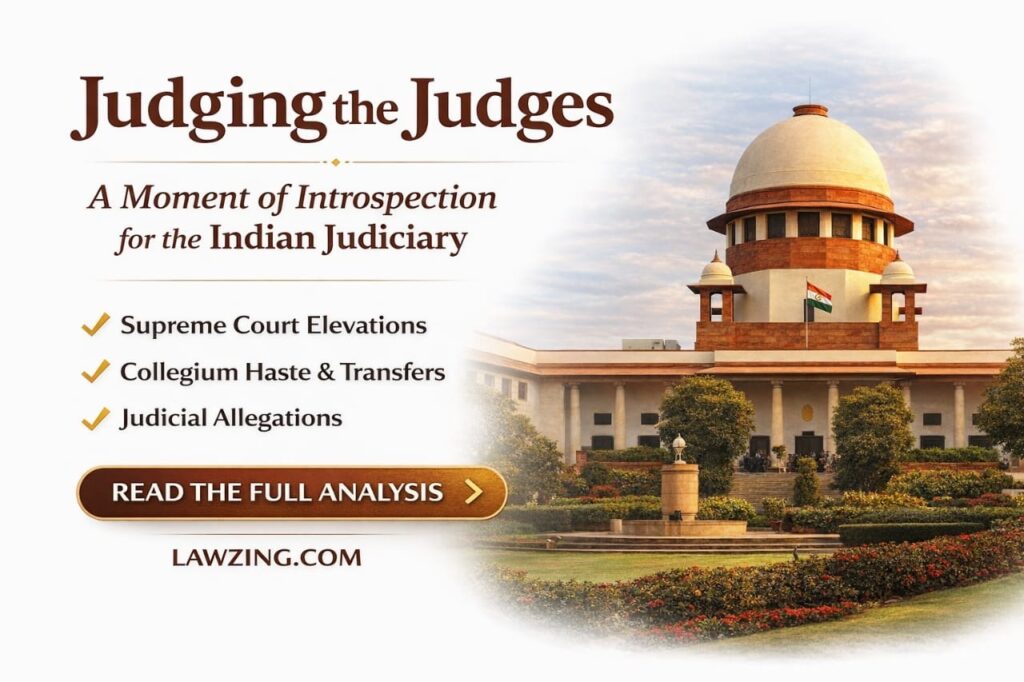
This erosion of confidence is not born out of a single judgment or controversy. It is the cumulative effect of recent developments that, taken together, raise serious questions about transparency, accountability, and institutional self-correction within the judiciary itself.
From a High Court Transfer to a Larger Constitutional Moment
The recent actions surrounding the Madras High Court collegium, the transfer of Justice J. Nisha Banu, and the hurried forwarding of four lists containing 24 names to the Supreme Court compel a serious constitutional reckoning. This is no longer about one judge or one High Court; it is about process, power, and public confidence in the judiciary as an institution.
According to widely published reports, the Madras High Court collegium sent four separate recommendation lists with 24 names within a matter of weeks. Judicial appointments have traditionally been cautious and deliberative. The sudden urgency to fill all vacancies raises questions about intent, particularly when no administrative emergency has been disclosed.
Timing, Retirement, and the Question of Collegium Haste
The timing becomes even more significant in light of the impending retirement of Justice M.S. Ramesh, a senior collegium member, by the end of the month. Once he demits office, the collegium’s composition would inevitably change. Acting before that date ensured that the recommendations could not be revisited by a differently constituted collegium.
This sequence has led many within the legal community to question whether the haste was administrative necessity or institutional strategy.
Transfer of Justice J. Nisha Banu and the Continuity of Office
Parallel to these developments was the transfer of Justice J. Nisha Banu, the second senior-most judge of the Madras High Court and a sitting collegium member. Though transferred on October 14, 2025, and later directed by a presidential notification to join the Kerala High Court on or before December 20, 2025, both notifications continued to describe her as a Judge of the Madras High Court.
Article 217(1)(c) of the Constitution, read with binding judicial precedent authored by former Chief Justice of India K.G. Balakrishnan, makes the legal position unambiguous: a High Court judge vacates office only upon assuming charge in the transferee High Court. A transfer order by itself does not sever the judge’s constitutional status in the parent court. Until such assumption of charge takes place, Justice J. Nisha Banu legally continued to be a Judge of the Madras High Court and, by necessary extension, a member of its collegium.
Collegium Composition, State Clarification, and Institutional Silence
Despite this settled legal position, the collegium proceeded to prepare and forward all four lists without Justice Nisha Banu’s participation. The Tamil Nadu Government did not object to the merit or suitability of the district judges recommended. Instead, it sought clarification on a fundamental procedural issue—the composition of the collegium itself.
As pointed out by Justice G.M. Akbar Ali, former Judge of the Madras High Court, in his published article, the State’s request was neither confrontational nor obstructionist. It was a legitimate constitutional query. That clarification remains unanswered.
Allegations of Ideological Preference and Exclusion
Sections of the Bar have alleged that the exclusion of Justice Nisha Banu, coupled with the haste in finalising recommendations before Justice Ramesh’s retirement, was intended to facilitate the inclusion of advocates perceived to be ideologically aligned with the BJP, RSS, or allied political formations.
These allegations may be contested. However, when ideology coincides with procedural opacity and unusual haste, the sequence of events inevitably creates public doubt.
Judiciary as Judge in Its Own Cause
If these actions are challenged, the judiciary itself will be called upon to decide the legality of its own conduct. This raises an uncomfortable institutional question: can an institution inspire confidence when it becomes judge in its own cause?
Courts routinely insist that allegations against the executive be investigated by independent agencies. Similar standards are conspicuously absent when allegations concern the judiciary.
Selective Accountability and Judicial Misconduct
Public unease is further compounded by instances where large sums of money have reportedly been recovered from the residence of a sitting High Court judge, with no visible criminal action thus far.
This disparity has led to a troubling question: does equality before law stop at the doors of the judiciary?
Speed of Supreme Court Elevations and Collegium Consensus
Concerns have been amplified by recent Supreme Court elevations completed within 24 hours, even where there was a recorded dissent by Justice B.V. Nagarathna.
Speed combined with dissent weakens public confidence in the deliberative nature of the appointment process.
International Investment, Economic Credibility, and Judicial Neutrality
India’s global economic credibility rests substantially on the belief that its judiciary is neutral, predictable, and independent. International investors rely not on political assurances, but on courts.
When judicial appointments appear ideologically filtered or procedurally contested, investor confidence erodes.
The Case for an Independent Mechanism
The growing concerns do not call for weakening judicial independence. On the contrary, they call for strengthening it through credibility and transparency.
India urgently needs a constitutionally independent mechanism to examine allegations relating to judicial appointments, transfers, and serious misconduct.
A Call for Institutional Introspection
The Chief Justice of India’s intervention is therefore necessary—not to defend individuals, but to defend institutional integrity.
When the judiciary becomes judge in its own cause, the cost is borne not by judges alone, but by democracy itself.

Respectful, well-reasoned, and necessary. The judiciary’s greatest strength has always been public confidence, and this article explains why safeguarding it matters.
A thoughtful and courageous article that calls for introspection, not confrontation. Judicial independence is strengthened—not weakened—by transparency and accountability.
A powerful and respectful article that asks uncomfortable but necessary questions about how the judiciary governs itself.
Reading and reflecting on this strengthens democracy.
Judicial independence is one of India’s most valuable institutional assets, relied upon by citizens and global investors alike.
This piece explains why transparency and accountability are essential to preserving that trust.
This article offers a balanced and necessary discussion on judicial transfers, collegium functioning, and public confidence.
Strong institutions grow stronger through introspection—not silence.
A powerful and respectful article that asks uncomfortable but necessary questions about how the judiciary governs itself.
Reading and reflecting on this strengthens democracy.
The article rightly highlights challenges the judiciary must confront internally—misuse of office staff, absence of criminal accountability mechanisms, and the lack of an independent body to examine allegations against judges. Addressing these issues openly will only enhance institutional dignity.
Just as courts insist on independent investigations when allegations arise against the executive, similar constitutional mechanisms are needed for the judiciary. This article makes a persuasive case for such reform through constitutional amendment.
This piece raises issues many hesitate to discuss: collegium integrity, internal accountability, and public trust. Such honest reflection is essential for preserving the dignity of courts.
Equality before law must mean everyone, including institutions.
This article explains why independent scrutiny of judicial processes is essential for public confidence.
Judicial reform is not anti-judiciary. It is pro-Constitution. This article articulates that distinction clearly and responsibly.
A timely reminder that no institution can remain above scrutiny if it seeks the trust of the people and the world.