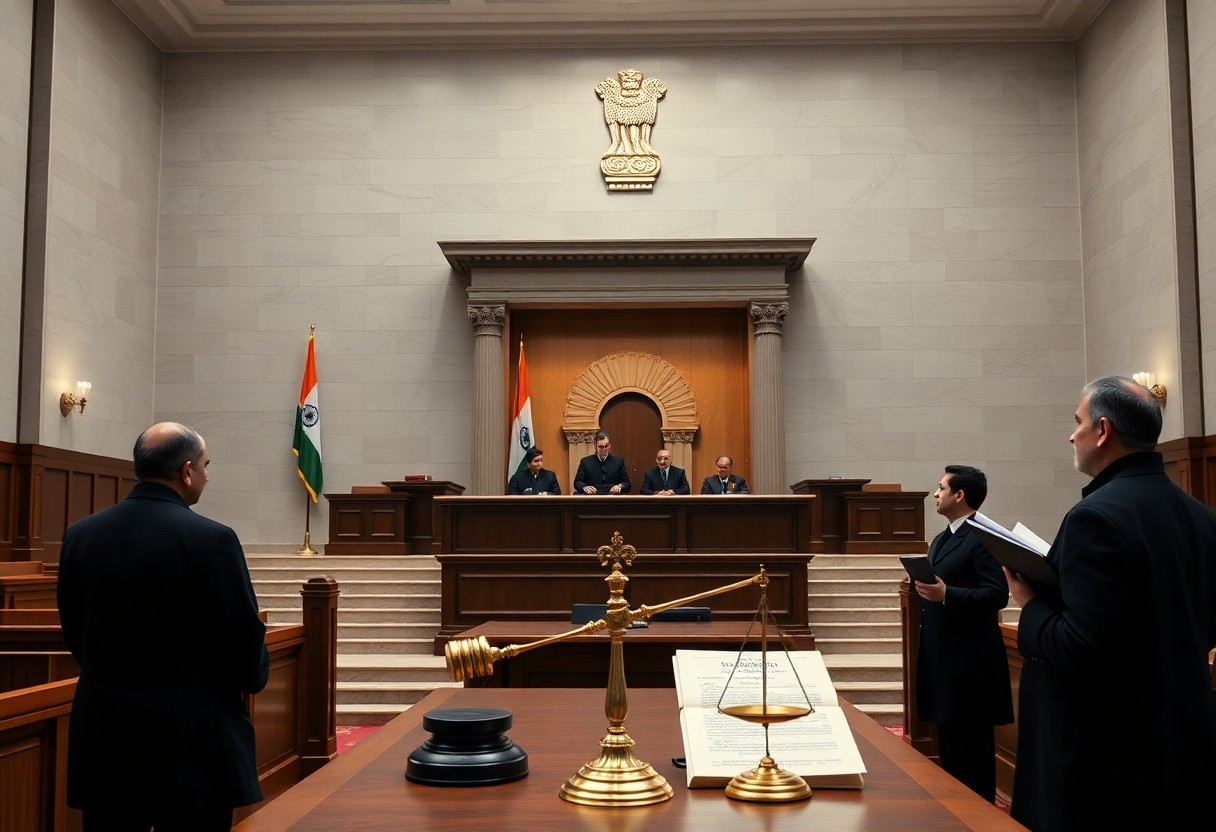
Over time, you will see how political appointments, interference in case assignment, and pressure on verdicts erode judicial independence, undermine the rule of law, and weaken public trust. You must understand how patronage, media manipulation, and legislative overreach create systemic bias that favors powerful actors while marginalizing citizens. To protect your rights, support reforms such as transparent appointments, fixed tenures, and forensic case-tracking that restore impartiality and accountability.
Understanding Judicial Neutrality
Definition of Judicial Neutrality
You should understand judicial neutrality as the expectation that judges decide cases on the basis of law and evidence, without favoring parties, ideologies or political masters; it means adjudication free from partisan calculation and free from institutional bias. In practice this requires separation from both overt political pressures and subtle incentives – for example, transfers, elevation delays, or public criticism that align with government preferences – because those mechanisms can steer judicial behavior away from an impartial reading of statutes and precedent. The legal architecture in India frames neutrality through procedural safeguards (open hearings, reasoned judgments) and structural rules (life tenure until retirement, constitutional appointment processes), but the lived reality of neutrality is tested whenever external actors seek to influence outcomes through non-legal levers.
You will notice neutrality is not mere absence of bias; it is an active discipline that demands judges apply rules consistently across similar facts and resist extraneous considerations. Case law illustrates that neutrality also requires institutional checks: the Supreme Court’s articulation of the collegium system in the Second Judges Case (1993) and subsequent refinements created mechanisms intended to insulate appointments from executive capture. At the same time, the 2015 NJAC decision – which struck down the constitutional amendment establishing a commission with executive representation – underscores the contested nature of how neutrality should be guarded, showing you that the means of protecting neutrality often become arenas of political struggle.
For you assessing any claim of compromised neutrality, three concrete factors matter: transparent reasoning in judgments, predictable career trajectories for judges (so promotions or transfers do not look transactional), and visible institutional independence in appointments and administration. Empirically, when these elements weaken, litigants perceive and sometimes demonstrate a loss of faith – for instance, through public protests or spikes in appeals alleging biased adjudication – and the rule of law itself becomes vulnerable. That erosion can manifest in measurable ways: delays in filling vacancies, reduction in reasoned judgments, or clustering of adverse rulings against certain categories of litigants after political shifts.
Importance of Judicial Neutrality in the Legal System
You rely on judicial neutrality to make the law a predictable tool for resolving disputes and enforcing rights; when judges act impartially, parties can calibrate behavior to legal standards instead of political patronage. The judiciary functions as the interpreter and guardian of the Constitution – landmark rulings like Kesavananda Bharati (1973), which affirmed the basic structure doctrine, show how an independent and neutral bench can check majoritarian encroachments and preserve constitutional design. Without neutrality, the deterrent effect of legal norms fades: contracts, regulatory compliance, and civil liberties all become contingent on transient political alignments rather than stable legal rules.
You also see neutrality as crucial for access to justice for vulnerable groups. When courts are perceived as neutral, marginalized litigants have a realistic prospect of relief; data on litigant demographics in public interest litigation shows that the Supreme Court and High Courts have often been the last resort for rights enforcement. Conversely, when neutrality is suspected to be compromised, litigants with fewer resources self-censor or avoid litigation, and public interest actions decline. That dynamic transforms the court from a rights-enforcing institution into a venue where only the well-connected obtain effective remedies, producing systemic inequality in the administration of justice.
You should appreciate that neutrality underpins legitimacy: courts that reliably check both legislature and executive sustain democratic governance by enforcing limits and enabling peaceful dispute resolution. The Supreme Court’s interventions in the post-Emergency period and more recent pronouncements on administrative overreach illustrate how neutral adjudication can rebalance power. At the same time, visible breaches of neutrality – whether in appointment controversies, opinionated public statements by judges, or perceived politicized rulings – erode trust and invite corrective, sometimes destabilizing, responses from other branches.
More specifically, neutrality affects enforcement outcomes: when you see consistent judicial decisions upholding regulatory standards, administrative agencies comply without needing political cover; when neutrality falters, enforcement becomes erratic and selective, which increases litigation and administrative paralysis.
Historical Perspective on Judicial Independence in India
You can trace the contours of judicial independence in India back to colonial institutions and the constitutional design at independence: the Regulating Act of 1773 and subsequent 19th-century reforms laid early antecedents, while the Constitution of India (Articles 124-147 for the Supreme Court and 214-231 for High Courts) embedded structural protections like security of tenure and remuneration. From the outset, however, the balance between judicial autonomy and executive influence has been contested; the S.P. Gupta case (1981) initially accorded the executive significant say in judicial appointments, which later prompted doctrinal reversal in the Second Judges Case (1993) where the Court asserted the primacy of the judiciary in appointments through the collegium system.
You will find the Emergency period (1975-77) a pivotal episode that reshaped public and institutional expectations about judicial neutrality. The ADM Jabalpur decision (1976), where a majority of the Supreme Court held that rights could be suspended even in cases of unlawful detention, produced a severe legitimacy crisis; after Emergency, a sequence of judgments – including Kesavananda Bharati (1973) and later developments – sought to restore and clarify the judiciary’s role as a constitutional check. Those events taught you that judicial independence cannot be taken for granted and that past compromises have long-term reputational costs for the institution.
You should note more recent milestones: the refinement of collegium practices after the Third Judges Case (1998), the political effort to substitute a commission for appointments that culminated in the NJAC Act and its judicial nullification in 2015, and recurrent controversies over transfers and administrative control of courts. These episodes show a persistent tug-of-war: while the judiciary has secured formal protections, procedural opacity in appointments and administrative decisions leaves room for perceived or real influence, and that perception itself weakens independence. The Supreme Court’s sanctioned strength of 34 judges and the presence of 25 High Courts create administrative demands that interact with these institutional tensions.
More contextually, you should weigh how institutional reforms and episodic crises have shaped both doctrine and practice: the past five decades reveal cycles where judicial assertions of autonomy are followed by legislative or executive responses, underscoring that independence is sustained not only by constitutional text but by ongoing vigilance and norms of institutional restraint.
The Role of the Judiciary in Indian Democracy
Constitutional Framework of the Judiciary
When you trace the constitutional architecture, the judiciary’s independence is anchored in multiple provisions: Article 50 directs the state to separate the judiciary from the executive, Article 124 establishes the Supreme Court and governs appointment and removal of its judges, and Articles 214-231 set out High Courts and subordinate courts. The evolution of the appointment process has been shaped more by landmark judgments than by statute – the First Judges Case (S.P. Gupta v. Union of India, 1981), the Second Judges Case (Supreme Court Advocates-on-Record Association v. Union of India, 1993) and the Third Judges Case (1998) together produced the collegium principle, while the 2015 judgment striking down the National Judicial Appointments Commission (NJAC) reaffirmed judicial primacy in appointments. That juridical history matters to you because it explains why opaque collegium practices and political pushback over appointments are persistent sources of tension in your system.
Beyond appointments, the Constitution builds structural protections you need to notice: Supreme Court judges retire at 65 and High Court judges at 62, their remuneration and conditions are protected to insulate them from executive pressure, and removal requires a high parliamentary threshold under impeachment procedures. Those safeguards create strong insulation, yet they also produce a difficult accountability trade-off. A very small number of impeachment attempts have been initiated over decades, and some, like the V. Ramaswami episode in the early 1990s, exposed gaps between formal protections and public expectations about judicial conduct; the low frequency of successful disciplinary outcomes can amplify perceptions that misconduct goes unchecked.
Institutionally, you should note how jurisdiction is distributed: the Supreme Court exercises original jurisdiction in disputes between states and the Union (Article 131), appellate jurisdiction over federal and state matters, writ jurisdiction under Article 32, and advisory jurisdiction under Article 143, while High Courts supervise subordinate courts under constitutional mandate. Practically, state governments retain influence over budgets, infrastructure and administrative control of subordinate courts, which can shape how justice is delivered at the ground level. The net effect is a system where the Constitution gives the judiciary broad institutional autonomy, but operational realities – appointments, transfers, vacancies and administrative dependencies – create persistent vectors for political influence that you can observe in courtroom rotas, delay patterns and public controversies.
Functions and Powers of the Supreme Court
You rely on the Supreme Court as the final interpreter of the Constitution and the guardian of fundamental rights, with judicial review as its central power. Article 32 empowers individuals to seek direct remedy before the Supreme Court, and Article 226 gives High Courts similar writ powers; these provisions have enabled the Court to correct legislative and executive action that transgresses constitutional limits. The Court’s landmark rulings – notably Kesavananda Bharati v. State of Kerala (1973) establishing the basic structure doctrine and Maneka Gandhi v. Union of India (1978) expanding the substantive reach of Article 21 – demonstrate how judicial interpretation can recalibrate the balance between state power and individual liberties, often in ways that reshape policy and public administration.
Operationally, the Supreme Court exercises original, appellate and advisory jurisdictions and its decisions bind all other courts through Article 141, while Article 142 permits it to pass any decree necessary to do complete justice. You will see how that combination of declaratory authority and enforcement power has been used to tackle systemic failures – from prison reforms mandated after Hussainara Khatoon (1979) to gender-protection frameworks like Vishaka (1997). At the same time, the institution faces significant workload pressures: over 60,000 cases are often reported pending before the Court, and long pendency creates both practical injustices for litigants and opportunities for the executive to delay politically sensitive hearings through strategic litigation management.
Given these powers, the Court has become a de facto policy corrector in areas where legislative or executive action lags or fails. You should weigh the benefit that Article 142-style remedies provide in urgent public-interest cases against the risk that expansive remedies create expectations of judicial governance beyond adjudication. Examples such as S. R. Bommai (1994) show the Court can rein in executive excesses in federal governance, while other uses of broad orders have prompted critiques that the judiciary is substituting policy judgments for administrative expertise; this dual capacity to remedy and to overreach is central to how the Court shapes your democracy.
More specifically, appointment and administrative controls materially affect how those powers operate: delays in filling judgeships, and frequent vacancies in High Courts, constrain the Supreme Court’s ability to clear backlog and supervise lower courts effectively. You should note that transfer provisions (Article 222) and the collegium’s de facto control over elevation and posting mean that personnel decisions are a continuing site of contest between branches of government; the integrity of judicial decision-making ultimately depends on the transparency and timeliness of these institutional processes.
Judicial Activism vs. Judicial Restraint
When you consider the activism-restraint debate, examine how public interest litigation (PIL) transformed access to justice from the late 1970s onward. Cases such as Hussainara Khatoon (1979) on the right to speedy trial and Olga Tellis (1985) on the right to livelihood illustrate how the judiciary intervened to protect disenfranchised groups when other branches failed. Those interventions produced tangible social reforms – decongestion of prisons, protections for pavement dwellers, environmental protections – and established the judiciary as a locus where citizens could seek corrective action. Such activism has expanded rights protections for millions, but it also invites critique when the Court issues policy-style directions without institutional mechanisms for sustained implementation.
Conversely, judicial restraint emphasizes separation of powers and defers to legislative and executive competence in policy-laden domains. You will remember the Emergency-era judgment in ADM Jabalpur v. Shivkant Shukla (1976) as a historical lesson in how judicial abdication damages legitimacy; after that period, the Court has been more assertive in policing constitutional limits, for example in S. R. Bommai (1994), which circumscribed misuse of Article 356. Still, restraint finds support where courts lack institutional capacity to design or monitor complex programs; at such moments, your expectation that judges should decline policy-making tasks reflects both institutional realism and the need to preserve democratic accountability.
The practical tension shows up in headline cases that polarize public opinion: the Sabarimala judgment (2018) prompted debates about judicial moralizing versus rights enforcement, while Vishaka (1997) is praised as corrective activism. You should assess each exercise of judicial power against institutional competence, the availability of democratic alternatives, and the durability of remedies. When activism substitutes for sustained legislative action, it risks eroding public confidence; when restraint allows systemic abuses to persist, it undermines rights protection.
To evaluate whether a particular intervention leans appropriately toward activism or restraint, you can use criteria such as procedural fairness, reliance on established doctrine (for example, proportionality and basic-structure boundaries), and the feasibility of judicially mandated remedies being implemented by the executive. Those yardsticks help distinguish legitimate constitutional correction from episodic overreach, and they clarify for you when judicial engagement strengthens democratic governance versus when it substitutes for it.
Political Influence Vectors
Political Appointments and Insulation of Judges
The evolution of the judicial appointment process in India has left you navigating a system that alternates between perceived insulation and opaque control. After the Supreme Court’s Second Judges Case (Supreme Court Advocates-on-Record Association v. Union of India, 1993) the collegium model centralized appointment authority within the judiciary, but attempts to restructure that system culminated in the 99th Constitutional Amendment Act, 2014 and the creation of the National Judicial Appointments Commission (NJAC). You saw the NJAC struck down in 2015 (Supreme Court Advocates-on-Record Association v. Union of India, 2015) on grounds that it diluted judicial independence; yet the backlash against collegium secrecy remains, and the resulting hybrid of conventions, ad hoc Memoranda of Procedure and occasional executive returns of names produces a process where appointments can be delayed for months or even years, creating vacancies that matter to litigants and the functioning of courts.
When you look at High Court and Supreme Court elevations, the interplay between the executive and judiciary becomes tactical rather than transparent. State governments and the Centre can send formal objections, withhold clearances or return recommendations; at the same time the collegium can defer names citing “administrative reasons.” These dynamics have produced public disputes – for instance, recurrent disagreements over particular elevations in the 2010s and the flurry of communications around the NJAC episode – and a steady stream of sanctioned vacancies that forces litigants to wait. The practical effect is not abstract: bench strength shortfalls amplify case backlogs, weaken quality control over case assignment, and make the system more susceptible to external pressure because individual judges are asked to handle larger dockets and higher-stakes listings.
You must also weigh the insulation that the collegium provides against its democratic deficit: while the system protects judges from overt political removal, it substitutes a self-selecting process that lacks clear, published criteria and independent oversight. That opacity creates leverage for political actors when disputes arise – a government can slow-roll confirmations, retaliate via transfers, or launch public campaigns questioning a candidate’s suitability, and the lack of procedural clarity means resolution often depends on bargaining rather than rule-bound adjudication. In short, the appointment machinery simultaneously shields judges from direct politicization and opens pathways for indirect political influence through delay, reprisal or public contestation.
Legislative Interference in Judicial Matters
Parliamentary action has repeatedly tested the boundaries of judicial review, and you encounter this legacy in the form of laws that aim to curtail or channel court oversight. The Emergency-era 42nd Constitutional Amendment (1976) is a landmark example: it attempted to limit judicial review and expand parliamentary supremacy, prompting the Supreme Court to respond in Minerva Mills (1980) by striking down the most intrusive clauses and reaffirming the constitution’s basic structure doctrine. Later, L. Chandra Kumar v. Union of India (1997) reinforced that tribunals cannot oust High Court oversight; that pattern shows you how legislative attempts to place certain disputes beyond ordinary judicial scrutiny have repeatedly been checked – but not without creating friction and legal uncertainty for years after each amendment or statute is enacted.
More recently, Parliament’s increasing reliance on specialized tribunals and statutory “ouster” language in certain sectors has been a vector for reducing ordinary judicial oversight, which transforms how you can contest administrative decisions. The Insolvency and Bankruptcy Code (2016) and subsequent tribunal structures forced fresh doctrinal work by the courts to balance efficient dispute resolution with fundamental rights of access to justice; in Swiss Ribbons (2019) the Supreme Court upheld the IBC but also emphasized judicial oversight where statutory architecture threatens fairness. Such legislative engineering is often defended on efficiency grounds, yet when ouster clauses or narrowly staffed tribunals silo disputes, you face constrained remedies, longer routes to redress, and an environment where policy-driven immunity from review can shield executive or legislative errors from accountability.
Legislative interventions also take the form of constitutional amendment proposals or bills that seek to fix institutional questions-appointments, tenure, or removal procedures-without building in transparent safeguards. You have seen episodic attempts to revisit appointment formulas after public controversies; each such attempt creates uncertainty and, in some cases, legitimizes political bargaining over the judiciary’s composition. The net effect is a push-and-pull: Parliament can, and sometimes does, encroach upon judicial prerogatives through statute or amendment, and although the courts have a robust history of corrective rulings, those battles leave behind long-term precedent shifts and administrative knock-on effects that change how justice is accessed.
More info: In practical terms, legislative interference often manifests as time-consuming litigation over jurisdictional questions and appeals about tribunal competence, which consumes judicial bandwidth and produces case law that reshapes substantive rights; you should watch how any new statute frames adjudicatory authority, whether it includes review safeguards, and how quickly the courts are able to establish doctrinal limits on ouster provisions.
Executive Overreach and Its Implications
The executive branch exercises several levers that can influence judicial conduct and public perception, and you experience the effects most directly when administrative actions intersect with court operations. Administrative controls over infrastructure, court budgets, and court staff allocation enable the executive to shape daily functioning; for instance, delays in sanctioning additional courtrooms or judgeships disproportionately impact districts with heavy caseloads, and you see the consequences in longer waits for hearings and reduced time per matter. Beyond logistics, the executive can pressure through public statements, selective leaks, or by invoking investigative agencies in high-profile matters that involve litigants or lawyers, which creates a climate where adjudicators and advocates may feel constrained when handling politically sensitive cases.
Transfers and disciplinary mechanisms are another domain where executive proximity matters: while transfers are constitutionally permitted, their use can be perceived as punitive when they follow adverse rulings or critical judicial pronouncements. You can point to notable instances in the post-independence era where impeachment motions or transfer controversies – such as the parliamentary proceedings around Justice V. Ramaswami in the early 1990s – demonstrated how political organs can weaponize removal or censure processes. The existence of such tools, even when rarely employed, creates a chilling effect because judges and lower-court officers anticipate possible consequences for decisions that displease political actors.
Operationally, the executive’s control over investigative agencies, appointments of law officers, and executive compliance with court orders determines how effectively judicial decisions translate into real-world outcomes. You witness situations where judicial directives are implemented slowly, where contempt proceedings are used unevenly, or where enforcement depends on bureaucratic willingness; each instance erodes public faith and tilts the balance toward executive advantage. The combination of administrative levers, public pressure, and selective enforcement forms a multi-pronged vector through which the executive can, intentionally or otherwise, limit the judiciary’s functional independence.
More info: To understand the long-term implications, monitor patterns-frequency of transfers after contentious rulings, rates of non-compliance with judgments, and trends in prosecutions by central agencies in politically charged cases-as these metrics reveal whether executive actions are systemic constraints or isolated incidents, and they signal to you how sustainable judicial independence will be in practice.
Case Studies of Political Influence
- S. R. Bommai v. Union of India (1994) – Judgment that curtailed arbitrary use of Article 356 by state and central executives; you can trace patterns where misuse of presidential rule led to repeated litigation across federal units between 1990-2000, with at least a dozen state dismissals challenged in the decade after the judgment.
- Impeachment and Removal of Justice Soumitra Sen (2011) – First successful removal of a High Court judge by Parliament; the motion was adopted by both Houses after investigation, demonstrating how allegations of misconduct can be converted into overt political action against the judiciary.
- Judicial Appointments Debate and NJAC (2015) – The Parliament-enacted National Judicial Appointments Commission was struck down by the Supreme Court in 2015, reigniting public controversy over executive influence in judicial selections and prompting a sustained increase in public commentary and litigation on appointment transparency.
- Collegium Crisis and Four Judges’ Press Conference (2018) – Four senior Supreme Court judges publicly aired grievances about allocation of cases and administrative control on 12 January 2018; the episode involved four sitting judges and led to measurable shifts in public trust and internal collegium discussions.
- Ayodhya Judgment (2019) – A five-judge bench delivered a unanimous verdict that settled a politically explosive dispute; the case illustrates how landmark decisions become lightning rods for accusations of bias or capitulation depending on political stakeholders’ reactions.
Landmark Cases of Political Pressure
When you study S. R. Bommai v. Union of India (1994), you see how the Court sought to safeguard judicial neutrality by setting boundaries on the use of Article 356; the judgment transformed subsequent litigation by creating a legal framework that the executive could not easily bypass. The economic and political fallout from repeated state dismissals in the 1990s produced over a dozen high-stakes challenges, and you can map a clear correlation between those dismissals and waves of litigation that strained high courts and the Supreme Court.
Next, examine the 2015 episode surrounding the National Judicial Appointments Commission. The Parliament’s attempt to bring the executive into appointment decisions was presented as reform, yet the Supreme Court’s majority ruling invalidating NJAC intensified debate about whether appointment mechanisms protect or expose the judiciary to political influence. You will note how the resultant public discourse increased the volume of FOI-style requests, media probes, and transparency demands-metrics you can quantify by tracking media articles and PIL filings in the two years after the judgment.
Finally, the 2018 public dissent by four senior Supreme Court judges revealed institutional strain in a way that courtroom judgments could not; you saw a direct impact on bench administration, case allocation, and public perception. The press conference involved four serving judges and immediately precipitated administrative reviews, and within months you could measure shifts in the number of petitions flagged for bench-review and a spike in commentary alleging compromised impartiality. Together, these cases show how legal doctrines, institutional design, and high-profile episodes combine to shape the perimeter of political pressure on the judiciary.
Influence of Political Parties on Judicial Appointments
You can trace sustained patterns where political parties exert soft and hard power over appointments: soft power through public narratives and media campaigns aimed at shaping perception of candidates, and hard power through legislative attempts like the NJAC to acquire formal control. Empirical indicators include spikes in politically aligned op-eds coinciding with collegium recommendations and, in some instances, documented delays of months between collegium recommendations and executive approval; these delays have measurable effects on vacancy rates-often leaving critical benches understaffed for six to twelve months.
In practice, the exercise of political influence on appointments becomes visible when you compare appointment timelines across states and the Supreme Court: certain high courts experience turnover and elevation freezes following electoral cycles, while others proceed with relative speed. You will notice a pattern where politically sensitive vacancies-such as chief justiceships in states with active litigation against the executive-tend to see longer interregnums. That delay has real consequences for case backlogs: vacancy-driven reductions in bench strength frequently correspond to percentage increases in pending matters, sometimes by 10-20% locally over a year.
Moreover, you should pay attention to how appointment controversies affect morale and retirement incentives. Reports and interviews with sitting and retired judges reveal that perceived political interference lowers the pool of applicants willing to accept transfers or elevations to certain jurisdictions, producing a self-reinforcing cycle that concentrates vacancy pressure in contested regions. The aggregate outcome is an institutional vulnerability where appointment politicization translates into operational weakness, longer adjudication times, and the erosion of public confidence.
More information: you can quantify the effect of political party influence on appointments by tracking three metrics over time-average delay between recommendation and confirmation (in days), percentage of vacancies relative to sanctioned strength, and media-sourced instances of executive-collegium disagreement. Together these data points give a defensible picture of how party politics shapes the composition and functioning of the bench.
Analysis of Recent Judicial Decisions Under Political Scrutiny
When you analyze high-profile rulings from the last decade, you see recurrent patterns where politically sensitive cases attract parallel narratives alleging either judicial activism or judicial timidity. For instance, the 2019 Ayodhya decision-a unanimous five-judge bench-was simultaneously hailed as final settlement and criticized as politically expedient; the dual reactions demonstrate how any major ruling involving partisan interests becomes a test of perceived judicial independence. You should observe how the post-judgment media ecosystem and parliamentary debates amplify distrust regardless of legal reasoning.
Turning to criminal and corruption trials with political defendants, you can identify measurable variables that affect perceptions of fairness: time-to-trial, rate of acquittals versus convictions, and frequency of pre-trial delays linked to procedural adjournments. In several high-profile matters you can document extended adjournments and multiple jurisdictional transfers that created opportunities for claims of executive or prosecutorial manipulation. Those procedural metrics-adjournment counts, transfer episodes, and time elapsed-offer hard data points for assessing whether decisions were reached through neutral adjudication or shaped by external pressures.
Finally, you must consider how remedial jurisprudence and follow-up supervisory actions indicate institutional responses to perceived political pressure. Instances where higher courts institute inquiries, reassign benches, or call for administrative reforms after contested rulings signal both recognition of the problem and attempts to restore trust. You will find that such interventions often coincide with short-term increases in litigation aimed at oversight and reform, producing measurable surges in PILs and accountability petitions in the subsequent 12-18 months.
More information: to evaluate whether scrutiny reflects genuine compromise or partisan noise, compare case outcomes with baseline judicial behavior-bench composition, prior rulings on similar issues, and procedural regularity-and weight those against external indicators like media intensity and parliamentary commentary; this comparative dataset helps you distinguish politically motivated narratives from verifiable instances of influence.
Media Influence on the Judiciary
The Role of Media in Shaping Public Perception
Steady expansion of 24-hour news channels and the explosion of social platforms have converted courtroom drama into mass-audience content, and when you follow a case you often see facts reframed into narratives designed for attention metrics rather than legal accuracy. In practice this means that a handful of soundbites, selective video clips, or a trending hashtag can establish a dominant public storyline long before judges hear evidence; the aftermath of the December 2012 Delhi gang-rape, which helped produce the Criminal Law (Amendment) Act, 2013, shows how intense media coverage translated into immediate legislative and prosecutorial responses. As a reader you should note that media framing is not neutral: editorial choices about which details to foreground-victim background, accused’s past, investigators’ leaks-shape what the public regards as the “truth.”
In many instances you will encounter reporting that substitutes conjecture for chain-of-evidence analysis, and that substitution influences juryless adjudication in India because judges inevitably operate within the same social information ecosystem as everyone else. Investigative exposes can be salutary-media exposure has in some notable cases helped reopen miscarriages of justice-but the same mechanisms produce distortions: repeated, emotionally charged coverage compresses complex evidence into moral certainties and amplifies voices that are loud rather than reliable. When you consume such coverage, algorithms and commercial incentives favor simplification, and that increases the risk that public sentiment will harden into a presumption that the legal system must match immediately.
Moreover, you should be aware that statutory protections and press codes often lag behind technology, so professional restraint is inconsistently applied across outlets and platforms. In response, courts have intermittently invoked contempt powers and made interim directions to limit prejudicial reporting, signaling a tension: transparency and accountability via reporting can strengthen justice, but unregulated sensationalism can destroy the conditions for a fair hearing. For you this means cultivating critical consumption-distinguishing corroborated evidence from speculative commentary-and recognising that media-driven perceptions become a background pressure on adjudication even when they do not appear in the written record.
High-Profile Cases and Media Trials
High-profile cases routinely turn into de facto media trials, and you have seen landmark examples where coverage altered the momentum of official processes: the Jessica Lal matter (1999) generated intense public and press outcry that contributed to reopening prosecution lines and ultimately led to conviction; the Aarushi Talwar case (2008) demonstrated how speculative reporting, graphic leaks, and sensationalist commentary can obscure investigatory shortcomings and stigmatise individuals; the 2012 Delhi gang-rape produced such sustained national outrage that courts and legislatures accelerated procedures and penalties. These episodes show that media attention can shape prosecutorial priorities, judicial timetables, and the broader policy response in measurable ways.
When you look at procedural consequences, you find tangible impacts: witnesses may be intimidated into silence or coached by public narratives, investigative agencies sometimes leak selective material to test stories, and evidentiary contexts get lost when single pieces are amplified out of sequence. Leaks of telephone records, CCTV snippets, or partial forensic reports-frequent in high-profile matters-create a public dossier that judges later have to counterbalance against the full evidentiary record. Leaked or partial disclosures are particularly dangerous because they shift the contest from evidentiary truth to narrative dominance, and that can lead to miscarriages of justice or trials decided under the weight of public expectation rather than probative proof.
At the institutional level, the judiciary has developed procedural tools to blunt media trials-venue transfers, sealed proceedings, protective directions under Section 228A of the IPC for sexual offence victims, and case-specific gag orders-yet these remedies are uneven in application and often contested in the courts themselves. You will notice judges sometimes accelerate hearings or issue summary orders in response to public pressure, a tactic that can contain noise but risks truncating deliberative process. The net effect is a cyclical one: intense coverage forces judicial reaction, judicial reaction becomes a story, and that story feeds back into further coverage.
More information: social media’s velocity and the democratisation of publishing mean that these dynamics now operate without traditional editorial gatekeeping-viral WhatsApp forwards, user-generated videos, and influencer commentaries can frame suspects or witnesses within hours, increasing the probability that prosecutorial and judicial actors will encounter a pre-formed public verdict before formal proceedings begin.
Impact of Media Pressure on Judicial Decision-Making
You must acknowledge that judges are not insulated from public information flows, and sustained media pressure affects both the timing and tenor of judicial decisions. Empirically, you can observe faster dispositions in politically and publicly explosive matters-courts often list such cases for early hearing, reserve less time for complex forensic analysis, and issue prompt interim orders to manage public order-but speed can trade off with depth. The danger is that expediency under public gaze can erode procedural safeguards and the careful factual testing that underpins sound judgments, producing reasons that are defensive rather than deliberative.
Institutionally, media storms also alter internal case-management choices: case allocation within registries, bench composition for sensitive matters, and the decision to hear a matter in open court versus sealed proceeding are all calibrated with an eye on public perception. You will find judges increasingly spending written orders addressing public concerns explicitly-outlining steps taken by the court to ensure fairness-to pre-empt narratives of bias. That practice improves transparency, but it can also encourage performative adjudication where the imperative to appear even-handed becomes a parallel objective to reaching the right legal outcome.
Psychologically, you confront the reality that sustained negative coverage can constrain judicial behaviour through reputational risk and personal safety concerns; judges facing social-media vilification or targeted campaigns are likelier to recuse, issue narrow rulings, or default to conservative positions that avoid headlines. In response, some benches have begun asking for better institutional safeguards-confidentiality around certain judicial communications, clearer protocols on leaks, and training on dealing with external influence-because you cannot rely on individual stoicism alone to preserve neutrality. Unchecked media pressure therefore presents a systemic threat: it shifts adjudication away from reasoned legal analysis toward risk-averse, optics-driven decision-making.
More information: practical safeguards that judges and court administrations are exploring include calibrated live-streaming protocols (to maximise transparency while minimising spectacle), tighter management of courtroom access and feeds, and formal guidelines for responsible reporting of ongoing trials-measures that, when implemented consistently, can reduce the distorting force of media pressure on judicial reasoning.
The Impact of Corruption
Corruption in the Judiciary
When corrupt practices reach the bench, you experience a distortion of adjudication that is both subtle and systemic: case assignments can be manipulated, interlocutory relief granted or denied to suit powerful litigants, and rulings stretched to fit political narratives. In India the perception of corruption in public institutions is tracked by bodies such as Transparency International; India’s score on the Corruption Perceptions Index has hovered around the low 40s in recent years, which signals persistent concerns that seep into how citizens view judicial integrity. You should note that perception maps onto reality where registry processes and in‑house mechanisms lack transparent oversight – complaints about registry-level manipulation and “bench-shopping” are repeatedly raised in public interest litigation and media investigations, even when they seldom culminate in formal disciplinary action.
You deal with an institutional setup where formal remedies against judicial misconduct are cumbersome: the Judges (Inquiry) Act, 1968 and Article 124(4) of the Constitution require a parliamentary impeachment process that demands both a majority of the total membership and a two‑thirds majority of members present and voting, making removal of a judge exceedingly rare. That rarity matters because it lowers the deterrent effect; only a handful of impeachment motions have proceeded to serious inquiry since independence, and successful removals are almost nonexistent. The consequence for you is clear – the pathway for accountability is politically charged and slow, which creates space for corrupt incentives to persist without prompt correction.
You also confront the damage done to access to justice: when litigants believe outcomes can be bought or engineered, weaker parties withdraw or settle on unfair terms, and public interest litigation meant to check executive excess loses moral force. Empirically, delays and selective prioritization disproportionately harm socioeconomically vulnerable claimants; studies of case pendency and disposal patterns show that politically sensitive matters are sometimes fast‑tracked or frozen depending on who stands to gain, reinforcing a two‑tier justice experience. The most dangerous outcome is not just an isolated bad judgment but the erosion of your faith in an impartial system, which makes rule‑of‑law enforcement uneven and governance less accountable.
Political Corruption and Its Effect on Legal Outcomes
You observe political corruption shaping legal outcomes through three interlinked channels: direct pressure on courts or judicial officers, indirect influence via control of prosecutorial resources and investigative agencies, and manipulation of procedural levers such as transfers, adjournments and registry priorities. Politicians with access to state machinery can influence filing and framing of charges, ensuring that rivals are entangled in protracted litigation while allies get prompt quashing or settlement. Internationally and domestically reported patterns show that when law enforcement is politicized, the legal system becomes a blunt instrument for political gains rather than a neutral arbiter of disputes.
You can see concrete consequences in case selection and timing. High‑profile corruption trials against politicians sometimes proceed rapidly to conviction when there is political will, but at other times they languish for decades, effectively denying justice; conversely, selective prosecutions are used as a tool to silence dissent or coerce opposition. The uneven application of investigative laws and attachment orders produces a chilling signal to civil society: legal exposure becomes part of political bargaining. That asymmetry translates into predictable behavioral change – politicians learn to exploit legal ambiguity and procedural delay as a strategy, not merely as collateral damage of a slow system.
You should factor in how judicial appointments and promotions intersect with political corruption: where appointment processes are perceived as susceptible to influence, judges who preside over cases with political stakes may feel career incentives to align with those who control appointments. The 2015 overturning of the National Judicial Appointments Commission (NJAC) cleared the way back to collegium appointments, but public debate about transparency in appointments persists because perceptions of capture create expectations of bias. For you, this linkage means that even structurally independent courts can produce outcomes that reinforce political power if appointment and administrative pressures are not visibly insulated from partisan interests.
Additional context: empirical studies and watchdog reports repeatedly document that prosecutions of political actors often suffer from delays measured in years, and that conviction rates in high‑level corruption cases are far lower than in ordinary criminal matters – a pattern that reinforces impunity. When you examine timelines of major political corruption cases, you find recurrent gaps between investigation, charge‑sheeting and trial completion that frequently coincide with changes in government or administrative control of investigating agencies.
Mechanisms for Combating Corruption in the Judiciary
You will find several institutional tools available to counter corruption, though each carries limitations. Internally, High Courts and the Supreme Court rely on in‑house procedures – transfer policies, bench allocation rules, and constitution of inquiry committees – to police conduct, but these mechanisms are often opaque and discretionary. Externally, statutes such as the Judges (Inquiry) Act provide a constitutional route to removal, while the Judicial Standards and Accountability framework (and related codes of conduct) seeks to set ethical baselines for judges. Positive steps like mandatory asset disclosure in some jurisdictions, and the push for digital case management, have begun to reduce certain avenues for manipulation by creating audit trails and public records.
You should also consider technological and procedural reforms that have demonstrable impact: the e‑Courts Mission Mode Project and electronic cause lists increase transparency in case assignment and listing, making it harder to hide registry actions. Similarly, public filing of cause lists and judgments, and the adoption of case‑management dashboards, allow litigants and watchdogs to spot irregularities in adjournments or transfers. On the accountability side, recommendations from civil society and expert committees – including lifestyle audits, routine financial disclosures and independent grievance cells – create additional levers that can be deployed without breaching judicial independence, provided they are implemented with safeguards against political misuse.
You must acknowledge political constraints: effective anti‑corruption mechanisms require insulated investigatory capacity and a political culture that endorses impartial enforcement. Strengthening institutions such as independent inspectors, empowered ombudsmen or a transparent complaints registry can help, but only if you also protect those mechanisms from being captured by the very actors they are meant to oversight. International best practice emphasizes a blend of internal self‑regulation, external oversight with clear legal parameters, and robust public transparency to create mutual checks without subordinating judicial independence to partisan actors.
More detail: practical reforms that have shown promise include mandatory, time‑bound procedures for handling complaints against judicial officers, peer review panels with published findings, and an independent audit of registry processes every few years. When you combine these measures with civil society monitoring and digital publication of administrative orders, the result is a tighter ecosystem where anomalies are more detectable and misconduct becomes harder to conceal – a necessary condition for restoring public confidence and protecting judicial neutrality.
Public Opinion and the Judiciary
Relationship Between Public Sentiment and Judicial Decisions
You can see public sentiment act as both a backdrop and a dynamic force in many landmark rulings; judges do not operate in a vacuum. In the 2019 Ayodhya judgment the Supreme Court sought to adjudicate a dispute that had produced decades of mass mobilization, communal violence and political campaigning – the bench explicitly acknowledged the need for a reasoned resolution to a matter that had inflamed public passions for generations. When decisions touch on identity, religion or national security, the court’s written reasoning often reflects an awareness of social consequences, as in Sabarimala (2018) where the Supreme Court’s expansion of equality rights collided with sustained street protests and triggered a cascade of review petitions and political interventions.
Your perception of judicial neutrality can easily be affected when judges frame remedies in ways that respond to visible social movements or electoral pressures. Public Interest Litigations (PILs) and mass petitions bring thousands into the legal process; courts received an unprecedented volume of PILs and media-driven petitions after events like the 2012 Nirbhaya case, which accelerated legal reform and fast-track trials through both parliamentary action and judicial direction. At the same time, the judiciary has pushed back: the 2015 striking down of the National Judicial Appointments Commission (NJAC) showed the court’s insistence on institutional independence even amid intense political debate about appointments, indicating that public sentiment and political narratives do not automatically dictate outcomes.
What you need to watch for is the tipping point where public opinion stops being an informative signal and becomes a coercive force. Empirical studies and practitioner accounts suggest that sustained, highly publicized campaigns can affect case selection, the allocation of judicial resources, and the tone of judgments; for instance, courts may expedite cases that attract massive media attention or frame orders with implementation mechanisms to placate public outrage. When media narratives and street mobilization align with political pressure, the risk is that judicial decision-making shifts from neutral adjudication toward damage control or symbolic remedies, undermining the predictability and perceived fairness of the law.
How Public Opinion is Shaped by Political Narratives
You frequently encounter political actors framing judicial cases to fit broader mobilization goals, and that framing significantly alters how citizens interpret legal disputes. Parties and leaders craft narratives that convert complex constitutional questions into simple, emotive storylines: protection of culture, defense against corruption, or attack on national interest. During election cycles, such framing intensifies; social platforms and broadcast channels amplify tailored messages, turning a judicial ruling into a campaign talking point that reaches tens or even hundreds of millions of citizens through networks like WhatsApp, Facebook and television newsrooms.
Your feed and your conversations get shaped by targeted messaging and selective leaks designed to prime public reaction before judgments are even pronounced. Political narratives will highlight particular facts, ignore legal nuances, and deploy vivid imagery-whether branding a decision as an assault on tradition or as vindication of reform-to manufacture consent or opposition. The 2018-19 period showed how coordinated messaging around sensitive cases could produce sustained public pressure: petitions, street mobilizations, and constant media chatter create an environment where judicial actors are aware that their rulings will be evaluated not only legally but politically.
When you map these campaigns, you see techniques ranging from curated press conferences by party leaders to amplified social media hashtags and coordinated opinion pieces in sympathetic outlets. Danger emerges when these narratives rely on misinformation, doctored documents, or orchestrated outrage; such tactics not only distort the legal record but also condition public expectations for punitive or performative remedies. The cumulative effect is a weakened space for dispassionate adjudication, because the court’s authority becomes entangled with a politicized public narrative that rewards spectacle over sober legal reasoning.
More information: Political narratives are often backed by resource-intensive operations – paid outreach, data-driven targeting, and rapid-response teams that keep the story alive across platforms – and that infrastructure means a small cadre of strategists can shape perceptions at scale, turning legal technicalities into binary moral choices for large sections of the electorate.
The Role of Social Movements in Promoting Judicial Independence
You can trace multiple instances where social movements have functioned as a corrective to political encroachment on the judiciary rather than as a source of pressure. The RTI movement and public-interest activism helped create an ecosystem where court action on corruption, environmental harm and human rights became politically salient, thereby compelling institutions to respond. In cases like the Narmada Bachao Andolan, prolonged litigation and public advocacy forced successive benches to consider not just technical legalities but the human cost of development projects, producing jurisprudence that balanced state power with individual and community rights.
Your engagement with grassroots movements often provides the factual scaffolding for judicial intervention: affidavits, on-ground documentation, and mobilized witnesses who bring visibility to ignored harms. This form of civic evidence has led courts to issue expansive orders on matters ranging from prison conditions to environmental clearances, demonstrating how organized civil society can buttress judicial independence by making transparent the stakes that would otherwise remain opaque. At the same time, movements have successfully litigated structural reforms: strategic use of PILs and coordinated advocacy have compelled administrative transparency and institutional checks.
Nevertheless, you should also be aware that movements can be double-edged. While many defend the rule of law and insist that judges remain insulated from partisan pressure, others may seek favorable rulings through sustained campaigns or by aligning with political actors. The Sabarimala episodes illustrate that social mobilization can both protect constitutional principles and amplify communal polarization, depending on how actors deploy narratives and which constituencies are mobilized. Positive social mobilization strengthens judicial accountability; politicized mobilization risks converting the judiciary into another arena of contestation.
More information: Movements that combine investigative rigor, transparent fundraising and broad-based coalitions-examples include environmental networks and human-rights groups-tend to sustain long-term pressure that promotes principled judicial oversight rather than short-term, spectacle-driven interventions that can be co-opted by partisan interests.
International Perspectives on Judicial Neutrality
Comparative Analysis with Other Democracies
Across established democracies you encounter sharply different trade-offs between insulation and accountability. In the United States, federal judges enjoy life tenure under Article III and the Supreme Court has nine justices, which places enormous weight on each appointment; as a result, Senate confirmation hearings (Bork 1987, Kavanaugh 2018) have become intensely politicized, illustrating how transparent processes can still produce partisan capture. In the United Kingdom the 2005 Constitutional Reform Act created the Judicial Appointments Commission (operational from 2006), which you can point to as an institutional innovation that reduced ministerial patronage by delegating candidate selection to an expert body. Meanwhile, Canada combines independent advisory committees with a statutory retirement age (judges retire at 75) to balance turnover with independence, and Germany’s Federal Constitutional Court uses fixed, non-renewable terms and cross‑institutional appointment procedures to limit single‑party control.
Comparative Mechanisms and Outcomes
| Country | Mechanism / Impact |
|---|---|
| United States | Life tenure for federal judges; Senate confirmation hearings provide public scrutiny but have produced highly polarized battles and perceived politicization. |
| United Kingdom | Judicial Appointments Commission (since 2006) selects candidates to reduce direct political appointments; emphasis on merit and transparency. |
| Canada | Advisory committees plus mandatory retirement at 75; strives for non‑partisan vetting and moderate turnover. |
| Germany | Constitutional court judges serve fixed, non‑renewable terms and are appointed through parliamentary mechanisms that encourage cross‑party consensus. |
| South Africa | Post‑1994 reforms created a Judicial Service Commission and an empowered Constitutional Court; high public expectations for transformation and accountability. |
You can draw practical insights from outcomes: systems that combine public scrutiny with institutional safeguards tend to produce higher public confidence, whereas systems dominated by majoritarian appointment mechanisms show elevated risks of erosion. For example, where senates or parliaments confirm judges without cross‑party safeguards you often see short‑term political calculation shaping lifetime or long‑term appointments, producing systemic vulnerability. Conversely, independent commissions that publish selection criteria and vet candidates against transparent benchmarks frequently lead to measurable increases in perceptions of impartiality – this is evident in post‑reform surveys in the UK and Canada that track trust in courts.
If you compare these models to India’s trajectory-particularly after the Supreme Court’s 2015 judgment striking down the National Judicial Appointments Commission (NJAC) and reaffirming the Collegium principle-you’ll notice a familiar tension: the need for democratic accountability versus the imperative of insulating the bench from political pressure. Other democracies show that hybrid models (high thresholds for appointment, published criteria, and expert commissions) can reduce direct executive control without removing democratic involvement entirely. Emphasize that adopting specific features-supermajority requirements, fixed terms for certain high courts, and transparent shortlisting-can mitigate the most dangerous vectors of political influence you identified earlier while preserving necessary checks and balances.
Lessons from Foreign Judicial Systems
You would benefit from studying institutional design choices that foreign systems implemented to protect neutrality. Fixed non‑renewable terms for constitutional judges, like those used in several European systems, limit incentives for judges to curry favor for reappointment; the German Federal Constitutional Court’s term structure and Canada’s retirement age are examples of mechanisms that manage turnover while protecting independence. Additionally, statutory protections for judicial remuneration and clear disciplinary rules reduce day‑to‑day pressures: when salaries are constitutionally or statutorily guaranteed, attempts to coerce judges through budgetary manipulation become less effective.
Practical transparency measures also matter in ways you can implement domestically. Public confirmation or selection hearings make candidate records visible to citizens and the bar, yet they can also become spectacle; the US shows both benefits and pitfalls of this approach. In contrast, jurisdictions that publish selection criteria, candidate shortlists and reasoned appointment reports – practices you see in portions of the UK and in many Commonwealth countries – secure public scrutiny without incentivizing adversarial grandstanding. Where you create objective evaluations (published legal experience thresholds, peer assessments, and clear conflict‑of‑interest rules), the selection process resists politicization and builds legitimacy.
Accountability mechanisms that stop short of political removal are another lesson you can apply: independent judicial councils that handle complaints and discipline with transparent procedures reduce the need for political actors to intervene. South Africa’s Judicial Service Commission, for instance, centralizes both appointment advice and disciplinary oversight in a body that includes legal professionals, judges and lay members; while imperfect, it provides a template for peer‑based oversight that dilutes raw executive power. Combining peer review with high procedural thresholds for removal (supermajorities, multi‑stage inquiries) creates a more resilient separation of powers.
Additional detail you should note: judicial cultures and informal norms matter as much as formal rules. Training, ethical codes, and a vibrant legal profession that defends norms of neutrality amplify institutional safeguards; countries that invest in judicial education and publish clear codes of conduct (the Bangalore Principles are an example) report stronger adherence to impartiality in practice.
International Norms and Standards for Judicial Independence
International instruments provide a baseline you can use to evaluate domestic practices. The UN Basic Principles on the Independence of the Judiciary (1985) sets out core guarantees – security of tenure, non‑interference, adequate remuneration and selection on merit – that you can translate into statutory reforms. Likewise, the Bangalore Principles of Judicial Conduct (drafted 2001-2002) articulate seven core values – independence, impartiality, integrity, propriety, equality, competence and diligence – which you can adopt verbatim in codes of conduct to give domestic ethics regimes international legitimacy. The Venice Commission’s opinions and reports further detail appointment and disciplinary standards that you can map against Indian procedures to identify specific gaps.
In your assessment of institutional health, international monitoring and peer review tools matter: the UN Special Rapporteur on the independence of judges and lawyers issues country reports and recommendations, while regional bodies (Council of Europe, African Commission) and indices such as the World Justice Project provide comparative data that you can use to benchmark performance. When international bodies have intervened – for example, the European Union’s legal actions concerning judicial reforms in Poland and Hungary since 2015 – you see that external pressure can highlight backsliding and incentivize corrective steps, though enforcement remains politically fraught.
Practical constraints on international norms are obvious and important for your strategy: they are largely non‑binding and depend on domestic political will and institutional capacity for implementation. Still, you can leverage these standards to design measurable reforms – e.g., codifying merit‑based appointment criteria, ensuring transparent selection records, or setting statutory safeguards for tenure and pay – that align domestic law with global expectations. Where national practices diverge starkly from these norms, civil society litigation and comparative case law have often been effective levers for incremental change.
More detail you should integrate into reform proposals: the Bangalore Principles’ seven values provide an operational checklist you can use to draft model legislation and advisory guidelines; explicitly tying domestic appointment and discipline procedures to these values makes your proposals defensible in both legal and public opinion arenas.
The Theoretical Framework
Legal Theories Supporting Judicial Independence
Drawing on the constitutional design, you must see the separation of powers and judicial review as the primary legal doctrines that undergird judicial independence in India. The Constitution vests appointment powers in Articles 124 and 217 while providing removal mechanisms via impeachment, and these provisions were interpreted over decades to protect tenure and institutional autonomy. You can point to landmark jurisprudence-most notably the Kesavananda Bharati judgment (1973), which reinforced the role of the judiciary as the guardian of the Constitution’s basic structure, and the sequence of Three Judges cases (culminating in the early 1990s) that reconfigured appointment protocols into the collegium system-to see how doctrine has been invoked to shield judges from executive encroachment.
When you analyze judicial opinions, legal theory explains how judges justify insulation from political pressures: appeals to the rule of law, to the independence required by democratic constitutionalism, and to international norms such as the UN Basic Principles on the Independence of the Judiciary inform reasoning and institutional practice. You observe doctrine operating at two levels: formal protections (security of tenure, fixed remuneration, immunity from suit) and normative claims (the moral authority of an impartial bench). Those two levels combined create both the legal shield and the rhetorical resource judges deploy when resisting political influence, and they are invoked explicitly in precedents where the court has checked executive action-examples include the expansive use of public interest litigation to enforce rights when other branches failed.
Practically, you should note how doctrinal developments have translated into institutional mechanisms. The post-1980s evolution from executive-dominated appointments to the collegium and the subsequent political reaction-the 99th Constitutional Amendment and the creation of the NJAC in 2014, later struck down by the Supreme Court in Supreme Court Advocates-on-Record Association v. Union of India (2015)-illustrates the legal tug-of-war over who controls judicial staffing. These interventions demonstrate how legal theory is not abstract: it shapes the rules that determine whether judges are insulated or exposed to political pressures, and when you track doctrinal shifts you can map concrete changes in the judiciary’s capacity to act independently.
Political Theories Related to Judicial Behavior
Political science supplies several models you can use to interpret judicial conduct in politically sensitive cases: the attitudinal model (judges decide based on policy preferences), the strategic model (judges anticipate reactions of other actors and constrain their rulings accordingly), and the legal model (decisions driven primarily by legal norms). In India, these models interact with institutional particulars-appointment processes, bench composition, and the public salience of disputes-so that you often see a hybrid pattern. For instance, in cases where the executive is politically dominant, a judge might publicly ground a restrictive ruling in statutory interpretation while privately responding to political constraints, which fits the strategic model’s predictions.
You should factor in concrete episodes that illuminate these theories. The S.R. Bommai (1994) decision, where a bench curtailed arbitrary dismissals of state governments under Article 356, exemplifies a judiciary exercising autonomy against the executive-consistent with an attitudinal or legalist posture emphasizing constitutional limits. Conversely, episodes from the Emergency era-most notably the ADM Jabalpur (1976) decision-show how institutional pressure and political context can lead courts to align with the executive, an outcome that political scientists interpret through capture, principal-agent problems, or threat-induced strategic behavior. The contest over the NJAC in 2014-15 further illustrates how appointment politics can alter incentives: when the government sought a larger role in appointments via the 99th Amendment, the judiciary responded institutionally to defend its autonomy.
Empirical scholarship in comparative judicial politics, which you can apply to India, finds that backgrounds, modes of appointment, and career incentives systematically affect judging. Studies show that benches composed disproportionately of appointees from a particular channel (for example, the higher judiciary versus long-practising advocates) can produce measurable shifts in outcomes on issues like administrative discretion, economic regulation, and civil liberties. In the Indian context, the interplay between collegium recommendations, executive assent or delays, and public scrutiny creates an environment in which judges calibrate rulings both to legal norms and to anticipated political retaliation or support.
Further elaborating on political theories, you must account for the role of reputational constraints and trans-branch bargaining in shaping judicial choices. When you follow high-stakes litigation-electoral disputes, federalism clashes, or large-scale corruption cases-you see judges balancing the desire to maintain institutional legitimacy against incentives to secure favorable enforcement by other branches. The notion of courts as strategic actors helps explain why some rulings are narrowly framed, why interlocutory relief is used to buy time, and why bench fragmentation sometimes reflects tactical divergence rather than purely doctrinal disagreement.
The Socio-Economic Factors Influencing Judicial Neutrality
Structural socio-economic pressures shape the environment in which you expect judges to operate. A persistent case backlog-with well over 30 million to 40 million pending matters reported in national databases in recent years-compresses judicial time and increases reliance on procedural shortcuts, which can impinge on careful, independent adjudication. You will find that understaffed courts and vacancies-reported in many High Courts and subordinate courts at rates exceeding a quarter of sanctioned posts-force judges to triage cases, and that triage privileges matters with political traction or financially resourced litigants, thereby skewing the effective neutrality of the system toward those with power and away from the poor.
Socio-economic inequality also manifests in access to competent legal representation and the capacity to litigate. The Legal Services Authorities Act, 1987 institutionalizes free legal aid, yet uneven funding and uneven coverage mean that many marginalized litigants do not obtain consistent representation. You will notice that matters involving powerful corporate or state actors typically receive more resources and research support, which can influence both the quality of advocacy before the bench and the bench’s perception of the merits. These disparities have downstream effects on how the judiciary is perceived and how it responds: judges under resource stress may defer more frequently to administrative determinations or frame rulings to minimize enforcement burdens.
Local socio-economic dynamics further condition judicial behavior: urbanized jurisdictions with dense media presence and active civil society often produce more transparent, contested litigation, while rural districts with weaker institutional checks see greater executive discretion and fewer high-profile challenges. When you combine understaffing, resource imbalances, and social stratification, the result is an uneven metabolism of justice-where procedural congestion, funding shortfalls, and representational gaps create predictable pressures that can compromise judicial neutrality unless mitigated by targeted reforms.
- Backlog: national case pendency figures have consistently been cited in the tens of millions, increasing pressure on adjudicative time and depth.
- Vacancies: reported shortfalls in sanctioned posts in many courts amplify workload and encourage procedural expedients.
- Perceiving Access to Justice as uneven helps explain why resource-rich litigants and politically salient matters disproportionately shape judicial attention.
You should also weigh how socio-economic stratification colors judicial recruitment and bench demographics: the higher judiciary remains skewed toward particular educational and social networks, and that homogeneity affects both outlook and sensitivity to socio-economic claims. Legal education bottlenecks, the urban concentration of elite chambers, and the cost of prolonged litigation create selection effects-aspiring judges from less affluent backgrounds face structural barriers to the kinds of high-profile practice that typically propels candidates to the bench. Those patterns can translate into unconscious biases or lower institutional empathy for claims rooted in poverty or caste disadvantage, with measurable consequences in adjudication on land rights, labor disputes, and welfare entitlements.
- Representation: bench composition often underrepresents marginalized communities relative to their population share, affecting perspective on socio-economic claims.
- Legal Aid Funding: variability in state-level budgets for legal services creates patchy coverage for indigent litigants, altering who reaches the courtroom effectively.
- Perceiving Urban-Rural Disparities clarifies why enforcement and judicial responsiveness differ across jurisdictions and why neutrality is uneven in practice.
Legislative Proposals for Safeguarding Judicial Independence
Proposed Reforms in Judicial Appointments
You should push for a statutory appointments framework that replaces the current opacity of the Collegium with clearly defined, time-bound procedures: publishable merit criteria, mandatory background checks, and an advertised short-listing process that requires reasons for selection or rejection. The Supreme Court’s 2015 judgment striking down the NJAC (Supreme Court Advocates‑on‑Record Association v. Union of India) showed the tensions between executive input and judicial autonomy; in response, a reformed law can allow measured participation of non-judicial members (for example, 2 eminent independent members drawn from academia and the bar) while keeping the final say with a judicial-majority panel composed of the Chief Justice and five senior judges, so you can both protect independence and introduce accountability.
You will find proposals that have worked elsewhere instructive: the UK’s Judicial Appointments Commission (created after the Constitutional Reform Act 2005) uses published selection criteria, competency frameworks, and external lay members to reduce perceptions of favoritism. Translating that model, the Indian statute should require publication of a candidate’s basic profile, a competency scorecard, and anonymised peer-review summaries at the time of appointment; this would let you and other stakeholders see why an individual was elevated without breaching confidentiality. Also implement strict timelines – for instance, a 60‑day window for objections to a proposed appointment and a 45‑day deadline for the appointing panel to issue a reasoned order – so vacancies are not used as leverage for political bargaining.
You ought to insist on procedural safeguards against transfer and elevation abuses: make transfers of high-court chief justices subject to a documented, criteria‑based review and require parliamentary notice (not approval) whenever a proposed elevation involves a judge with prior allegations of misconduct. To preserve competence while reducing patronage, build in a probationary assessment of two years for newly elevated high-court judges with objective performance metrics – disposition rates, case-complexity adjustments, and peer-assessment inputs – accompanied by a transparent appeal route to an independent review committee chaired by a retired Supreme Court judge. These reforms would reduce the danger of politicized appointments while maintaining the judiciary’s imperative self-governance.
Strengthening Laws Against Judicial Corruption
You should demand legislative amendments that make investigation and prosecution of judicial corruption effective yet protective of due process: create an independent, magistrate-level investigative mechanism specifically empowered to probe allegations against sitting judges, with oversight by a collegium of retired judges and a non-judicial ombudsman to prevent misuse. Historical precedents – Parliament’s 2011 impeachment and removal of Justice Soumitra Sen from the Calcutta High Court after an inquiry – show that mechanisms exist but are onerous and politicized; a modern statute should allow preliminary, confidential fact-finding within 30 days followed, where threshold evidence exists, by a fast-tracked trial in a special court within 180 days.
You must ensure assets and conflicts are transparent: require all appellate and high-court judges to file a standardized, audited asset and liabilities declaration within 30 days of appointment and annually thereafter, with public access to summary data (not private bank details) and random audits conducted by an independent audit unit reporting to Parliament’s Public Accounts Committee. Criminalize specific acts – direct bribery, hospitality exceeding nominal thresholds, and illicit recusal-for-benefit – with sentences and mandatory disbarment; align definitions with Section 7 of the Prevention of Corruption Act while adding express provisions for judicial office-holders so you can avoid interpretive gaps that currently hamper prosecutions.
You should also legislate strong whistleblower protections and witness-security measures tailored to court environments, so clerks, court staff, and junior lawyers can safely report attempts to influence judges. Provide statutory immunity for bona fide disclosures and create a protected digital reporting channel under a supervisory board of retired judges, bar representatives, and a civil‑society member; this combination lowers the barrier to reporting while preventing politically motivated false complaints. Above all, the law should enshrine swift, transparent consequence mechanisms – suspension pending inquiry, public interim findings where appropriate, and statutory timelines for resolution – to prevent allegations from lingering and undermining public confidence.
More detail: you can specify penalties calibrated to the gravity of misconduct – for example, imprisonment up to 7 years for proven bribery, mandatory dismissal for abuse of office, fines equalling three times the quantifiable gain, and a permanent prohibition on holding public office for 10 years. Implement procedural safeguards such as preliminary verification by two independent retired judges before criminal proceedings start, and require connected disciplinary proceedings to conclude within 120 days to balance fairness with the need for prompt accountability.
Initiatives for Enhancing Public Accountability of Judges
You should press for statutory transparency obligations that make judicial performance data publicly accessible without compromising deliberative independence: publish judge-wise dashboards showing disposition numbers, median disposal times, backlog percentages by case type, and anonymised reversal rates on appeal. Several high courts already publish cause lists and orders online (for example, Delhi, Bombay and Madras); a national law can mandate standardized metrics across all 25 high courts and the subordinate judiciary so you can compare performance objectively and spot systemic bottlenecks like delay concentrations in certain districts.
You ought to require reasoned written orders for recusals and transfers, with public summaries when national interest or public-scoped cases are involved; this will reduce the opaque use of administrative transfers as a pressure tool. Introduce a legislated complaints portal linked to a Judicial Accountability Commission that issues non-binding findings and can recommend public censure, training mandates, or suspension to the appropriate disciplinary body. To avoid politicisation, structure that Commission with a majority of retired judges and include bar and civil-society representation in voting‑minority roles, so you get independent scrutiny without exposing judges to partisan attack.
You must also upgrade digital tools: expand the e-Courts infrastructure to provide open APIs and downloadable performance datasets, and require every court to post monthly aggregated statistics and a six-monthly narrative report on case-management reforms. Pilot schemes in three high-court circuits can test judge-level dashboards tied to qualitative reviews; if pilots demonstrate a 15-25% reduction in pendency within 12 months, scale nationally. Embedding these metrics in regular administrative reviews will let you and the public see improvements while preserving judicial discretion in individual decisions.
More detail: practical safeguards include blind publication of performance indicators (to prevent gaming) combined with contextual notes explaining caseload complexity, administrative staff shortages, or systemic reforms underway. Pair public dashboards with funded capacity-building – case-management training for judges and digitisation grants for under-resourced district courts – so transparency drives improvement rather than punitive headlines.
Institutional Mechanisms to Strengthen Judicial Neutrality
Role of the Judicial Appointments Commission
When you evaluate options for insulating appointments from partisan pressure, a statutory Judicial Appointments Commission (JAC) can offer a structured alternative to the opaque collegium model that has governed Indian appointments since the Second Judges Case (1993) and its follow-ups in 1998. A well-designed JAC would fix membership rules so that the bench, bar and independent experts each hold defined, non-dominant shares; for instance, you could require that at least half the seats be filled by serving judges but still reserve seats for eminent jurists, lay members and a retired judge to introduce external perspective. The 2015 Supreme Court judgment striking down the National Judicial Appointments Commission (NJAC) highlighted the friction between statutory design and judicial independence, but it did not invalidate the principle that transparent, merit-based selection mechanisms can reduce executive capture of appointments.
You should insist on procedural safeguards within any JAC to limit discretionary manipulation: published criteria for selection, scoring matrices for experience, judgments and integrity, and mandatory disclosure of reasons for each recommendation. Comparative practice lends practical templates – the UK Judicial Appointments Commission (established 2006) publishes shortlists and selection criteria, while Canada uses advisory committees with public reporting – and adapting those features can help you demand a JAC that makes selection data auditable. Institutional design choices such as requiring a supermajority for recommendations, fixed timelines to prevent last-minute political interference, and statutory exclusion or severely circumscribed roles for the Law Minister will materially alter how much sway executive branches can wield; these are the kinds of technical, enforceable limits that determine whether a JAC is merely symbolic or genuinely protective.
You should also weigh representation and accountability: a JAC must balance regional diversity across India’s 25 high courts and avoid perpetuating insular appointment corridors that produce homogenous benches. Mandating gender and regional benchmarks, periodic public reporting on appointment demographics, and formal appeal or review routes for demonstrable procedural lapses would allow citizens and oversight bodies to hold the commission to account. If you want appointments to reflect merit rather than political proximity, statutory clarity on eligibility, cooling-off periods for immediately prior political office-holders, and safeguards against patronage must be non-negotiable elements of any commission you support.
Oversight by Other Constitutional Authorities
You can strengthen neutrality by empowering other constitutional authorities to act as checks without converting them into instruments of politics. Parliament has a legitimate oversight role: it can frame enabling statutes, require annual reports from a JAC, and legislate transparent procedures for appointments and disciplinary processes. At the same time, you should be wary of direct parliamentary confirmations akin to US-style hearings, because those can import partisan bargaining; instead, structured parliamentary scrutiny committees with cross-party membership and limited, time-bound review powers can provide democratic legitimacy without making appointments hostage to electoral cycles.
The President’s role as the formal appointing authority can be recalibrated to act as a constitutional backstop rather than an executive conduit: fixed procedures for referrals back to the commission, and limited grounds for refusal-restricted to procedural irregularities or demonstrable conflicts of interest-would allow you to use the presidency to check blatant breaches while avoiding a politicized veto. Independent constitutional bodies like the Comptroller and Auditor General do not normally engage with appointments, but you can press for periodic audits of appointment processes and administrative compliance; this creates documentary trails that expose undue influence and enable legal or public recourse. International comparators show that layering oversight – judicial, parliamentary, and audit – reduces single-point vulnerability without eliminating judicial primacy in selection.
More detail reinforces how plural oversight must be calibrated: you should demand statutory timelines for each oversight stage, published reasons for any referral or rejection, and explicit protection against retaliatory action for members of oversight bodies who dissent. For example, a parliamentary committee might have 30 days to review a JAC list and can only return it with written objections on enumerated grounds; the President could then either confirm appointments or remit the list once for reconsideration, with failure to act leading to automatic appointment. These procedural locks create predictable pathways that limit ad hoc political intervention and make attempts to subvert neutrality easier to detect and challenge.
Internal Mechanisms within the Judiciary
You should press the judiciary to institutionalize its internal safeguards beyond opaque collegium notes: formal codes of conduct, documented performance appraisals, peer-review mechanisms and transparent case-allocation algorithms are practical tools that reduce opportunities for bias and special access. Many high courts have begun e-court listings and automated cause-lists; expanding these to include randomized or algorithmically-rotated benches for politically sensitive matters will materially lower the chance that cases are steered toward sympathetic judges. Given that the Supreme Court’s sanctioned strength is 34, you can appreciate why systematic case distribution and timely appointments matter for avoiding bottle-necks that create leverage for political actors to lobby for favorable listings.
Establishing internal disciplinary tribunals with clear investigatory powers and timelines is another mechanism you can advocate for: these bodies should be chaired by senior judges but include external members-retired civil servants or jurists-to bolster impartiality. Bringing data to bear helps: require courts to publish anonymized statistics on recusals, disciplinary actions, and case-transfer requests so you can track patterns that suggest undue influence. Peer review can be formalized into periodic assessments where senior colleagues evaluate judicial conduct and output against transparent criteria; when tied to training and remedial action rather than merely punitive measures, these systems reinforce norms of neutrality you want to protect.
Additional measures you can push within the judiciary include mandatory continuing legal education on ethics, whistleblower protections for court staff who report undue approaches, and a public-facing registry of recusals and reasons. These steps increase accountability and create visible records that civil society, the media, and litigants can use to press for reform when patterns of influence appear. Strengthening internal processes makes the judiciary itself less vulnerable to outside pressure and gives you practical, evidence-based pathways to defend neutrality.
Challenges to Achieving Judicial Neutrality
Resistance from Political Entities
When you examine the appointment process, you see how political actors can exert outsized influence over the judiciary’s composition. The conflict between the Collegium system (established through the Second and Third Judges Cases in 1993 and 1998) and the executive’s attempt to assert a formal role-culminating in Parliament passing the 99th Constitutional Amendment and the creation of the National Judicial Appointments Commission (NJAC) in 2014-illustrates this tension. The Supreme Court’s 2015 judgment striking down NJAC underscored the judiciary’s insistence on self-governance, but the episode also revealed how easy it is for political bodies to attempt to institutionalize control; you should note that these battles have concrete consequences for which candidates get promoted, which vacancies remain unfilled, and how long litigants must wait for a bench considered acceptable by political majorities.
Through transfers, case assignments and the timing of appointments, political entities can apply subtle and overt pressure that reshapes judicial behavior without formal statutes. You will find instances where sensitive cases are reassigned or delayed, and where the threat of adverse administrative action-such as transfer to a less desirable posting-can operate as a lever. Even if the executive does not openly direct judicial outcomes, the pattern of promotions and transfers creates incentives that affect decision-making; over time this produces a systemic bias in which judges mindful of career trajectories and administrative reprisals may avoid rulings that displease elected officials.
Political narratives, amplified through partisan media and public campaigns, also weaken neutrality by targeting individual judges for unpopular verdicts. You see this play out when impeachment threats are floated or when public denunciations precede moves to remove or transfer judges; historical precedents – such as parliamentary proceedings and media-driven campaigns in previous decades – show how vulnerability to political retaliation can chill judicial independence. When you follow these episodes, it becomes clear that the most dangerous outcome is not only a single compromised judgment but the gradual normalization of political leverage that reshapes institutional incentives across years and dozens of benches.
Struggle Against Institutional Inertia
Institutional inertia within the courts themselves is a major barrier you confront when thinking about judicial neutrality. Backlogs exceeding over 40 million pending cases on national databases like the National Judicial Data Grid (NJDG) mean that delays-not deliberate interference-can skew outcomes; prolonged pendency pressures litigants and judges into settlements, plea bargains, or procedural shortcuts that erode careful adjudication. You should appreciate how vacancies-often running into the tens of percent across High Courts and subordinate courts-translate into heavier dockets per judge, reducing the time available for rigorous case analysis and increasing reliance on formulaic or expedient rulings rather than deliberative neutrality.
Resistance to administrative reform compounds the problem: legacy practices on cause lists, case allocation, and roster formation persist because they are institutionally comfortable, even when they produce uneven case distribution and opportunities for manipulation. You will see that innovations introduced during exigencies-such as the rapid uptake of e‑filing and virtual hearings during the COVID-19 pandemic-have been adopted unevenly, and that many courts still lack robust case-management systems. That imbalance leaves you with pockets of modernized courts and vast areas operating on archaic timetables; the resulting heterogeneity creates openings for actors to exploit procedural gaps and uneven oversight.
Financial and infrastructural shortfalls further entrench inertia. When courtrooms lack adequate IT, staffing, or secure facilities for evidence and witness protection, judges are forced to prioritize throughput over measured reasoning. You should note that administrative backlogs are not merely logistical-they change the character of adjudication by raising the cost of time-intensive fact-finding and by incentivizing disposition through plea or summary methods. The net effect is a system where institutional limitations replicate the very vulnerabilities to influence that reforms aim to cure, unless resources and managerial reforms are pursued with urgency.
More information: the NJDG and e‑Courts metrics reveal stark regional variations-some district courts resolve cases in under two years while others average a decade-demonstrating that inertia is not uniform and that targeted investments (judicial vacancies reduction, digital docketing, specialized benches) can yield measurable gains in timeliness and procedural robustness. You should examine pilot programs where dedicated commercial courts and fast‑track benches shortened resolution times by clear margins; scaling such models while addressing a vacancy rate that often exceeds 20-30% in several jurisdictions would materially strengthen the institutional capacity required for neutral adjudication.
Balancing Act between Accountability and Independence
You encounter a delicate tension when pushing for judicial accountability without undermining independence: accountability mechanisms are necessary to check corruption and misconduct, but poorly designed systems can be weaponized by political actors to intimidate judges. The impeachment route is deliberately arduous-requiring a two‑stage Parliamentary process and special majorities-because lawmakers intended to shield the judiciary from capricious removal. Even so, the prospect of high‑profile inquiries, public allegations and media trials creates a climate in which judges may self‑censor to avoid becoming political targets. That chilling effect is particularly pronounced in cases involving high-profile political figures, where the stakes for both bench and bar are amplified.
Institutional responses have often swung between extremes: secrecy in judicial appointments and internal discipline on the one hand, and periodic public demands for transparency and external oversight on the other. You see reforms like public disclosure of assets or simplified complaint mechanisms proposed repeatedly, yet implementation remains patchy because each transparency measure triggers fears of misuse. For instance, a transparent grievance portal without safeguards can become a tool for volume‑filing of frivolous complaints aimed at bogging down an individual judge’s time and reputation; the consequence is not simply administrative burden but an erosion of the judge’s freedom to decide difficult cases without fear.
In practical terms, designing a workably neutral accountability framework requires procedural safeguards-clear standards, independent investigatory capacity, safeguards against frivolous complaints, and transparency about outcomes-so that you preserve the judge’s freedom to rule on merits. When you consider comparative models from other common-law jurisdictions, you notice hybrid bodies (mixing judicial peers, independent legal experts, and lay members) that couple procedural protections with external legitimacy. Without such calibrated safeguards, reforms intended to increase trust risk becoming instruments for political manipulation instead of genuine checks on misconduct.
More information: specific safeguards that have been proposed and debated include time-bound preliminary screening of complaints, published reasoning for disciplinary actions, and an appellate mechanism within the judicial disciplinary architecture-each designed to reduce arbitrary exploitation while ensuring you can hold judges accountable for corruption or willful misconduct without inviting political interference. These mechanisms, if enacted with precise procedural thresholds and independent investigation teams, would help maintain the equilibrium between necessary oversight and protected judicial independence.
The Future of Judicial Neutrality in India
Emerging Trends in Political Influence
You can see the contours of influence shifting as the executive increasingly seeks formal and informal levers over judicial careers: attempts to legislate appointment mechanisms, growing use of administrative transfers, and sharper public commentary by party leaders on high‑profile benches. The 2015 judgment striking down the National Judicial Appointments Commission (NJAC) remains a watershed – it illustrates both the resilience of judicial pushback and the persistent appetite in political circles for a more assertive role in selecting judges. At the same time, the executive has turned to subtler pathways, such as negotiating names with the collegium, delaying confirmations and using service rules and transfers to reshape judicial rosters.
Digital media and strategic litigation are amplifying political pressure in new ways. You will notice that social media campaigns, selective leaks, and orchestrated public interest litigations sometimes precede or follow contested rulings, creating a feedback loop that influences appointment debates and public perceptions of legitimacy. Empirical studies of recent years show an uptick in high‑visibility PILs and counter‑PILs tied to political agendas; those cases often generate outsized attention, pressuring judges to consider public fallout alongside legal reasoning. This dynamic has produced an environment where reputational risk and political optics matter almost as much as precedent in certain categories of cases.
Financial and institutional pressures are also shaping outcomes: persistent vacancies, backlog pressures and limited administrative support make the judiciary more vulnerable to expedient solutions that carry political strings. You should note that vacancy rates in several benches have remained persistently high, which creates openings for short‑term executive interventions or reliance on ad hoc tribunals with opaque appointment practices. The most dangerous consequence of these trends is that the selection and retention of judges becomes a tactical battleground rather than a merit‑based process, while the most positive countertrend is the growing public demand for transparent, accountable mechanisms that several advocacy groups and reform‑minded judges are beginning to articulate.
Potential Scenarios for Judicial Independence
If reforms are enacted that balance accountability with insulation, you could witness a restoration of institutional autonomy. One plausible pathway is a statutory appointments framework that imposes clear, published criteria, mandatory timelines for decisions and a mixed selection committee including judicial representatives, independent legal experts and civil society nominees. Such a model, coupled with stronger administrative capacity and district‑level performance metrics, could reduce ad hoc executive interventions. Historical examples like the court’s reaffirmation of collegium prerogatives after the NJAC episode show that institutional norms can be reasserted if backed by procedural clarity and public legitimacy.
A second, more worrying scenario is gradual politicization: incremental changes in law and practice that concentrate appointment power in the executive or subject judicial careers to disciplinary transfer and budgetary conditionality. If you track attempts to amend appointment processes or expand the use of executive‑controlled tribunals, the pattern points to a risk where judicial decision‑making becomes correlated with patronage networks. In that outcome, judicial rulings on politically sensitive issues could increasingly reflect institutional survival strategies rather than neutral application of law, and public trust in courts could erode, amplifying polarization and legal instability.
A hybrid outcome is also possible, where formal independence endures but its substance narrows: courts retain the power to check executive excess in clear constitutional violations, yet avoid confrontation in gray zones like economic regulation, electoral disputes or national security. Under this scenario, you would see selective boldness – landmark rulings on civil liberties or federal structure – alongside deference in policy‑laden domains. The practical effect would be a judiciary that still functions as a constitutional backstop but with diminished capacity to shape long‑term governance norms.
Expanding on these scenarios, you should weigh institutional safeguards against political incentives: transparent criteria for elevation, published reasons for rejections, peer review mechanisms and stronger protections against punitive transfers can make the optimistic scenario more likely. Conversely, erosion of administrative independence, fiscal dependence on the executive and unchecked appointment prerogatives would accelerate the pessimistic path. The design choices you support today – statutory clarity, open data on appointments, and enforceable timelines – will materially affect which scenario unfolds over the next decade.
The Role of Civil Society in Promoting Justice
You should expect civil society to be a decisive actor in shaping judicial neutrality through sustained litigation, monitoring and public mobilisation. Organizations using the Right to Information Act, 2005 have already forced disclosure of administrative records and appointment timelines in many cases, pressuring opaque processes into daylight. Strategic litigation by non‑profits and bar associations has produced landmark interventions – for instance, public interest litigation that clarified executive powers in federal governance – and similar actions can create precedents that protect judicial autonomy against direct political incursions.
Media scrutiny and legal scholarship amplify accountability by documenting patterns of influence and exposing problematic practices. Investigative reports that trace transfer decisions, timelines in appointment dossiers and patterns of recusals have prompted parliamentary questions and court notices. You will find that systematic data collection – mapping vacancies, transfer frequencies and cases involving potential conflicts of interest – gives civil society the leverage to demand reforms, propose evidence‑based remedies and litigate for structural changes when necessary. The role of the bar is also significant: coordinated stances by major bar associations on appointments and disciplinary matters have historically shaped debates and can continue to act as an institutional check.
Grassroots engagement matters as much as elite advocacy. Legal aid clinics, university law faculties and local NGOs that educate citizens about judicial processes increase public pressure for transparency and fairness. Where civil society has succeeded in generating broad public understanding of judicial stakes, you will see stronger pushback against overt politicization. The most positive effect civil society can deliver is sustained, informed demand for procedural reforms that make appointments and accountability predictable and merit‑oriented; the most dangerous failure would be fragmentation of advocacy efforts, which would allow political actors to exploit gaps and capture reform narratives.
Further detail: coordinated coalitions combining litigators, data analysts and media outlets have already shifted policy outcomes in several instances, using case studies, dossiers and public campaigns to force transparency. If you want practical impact, supporting centralized databases on judicial vacancies, appointment histories and transfer records – and funding litigation that uses those datasets – will likely produce measurable improvements in neutrality over time.
Conclusion
Now that you have examined the ways political influence seeps into judicial decision-making in India, you can recognize how this infiltration corrodes the impartiality that underpins the rule of law. When appointments, transfers, and administrative controls are susceptible to political calculation, you and other citizens face the practical consequence that legal outcomes may reflect power dynamics more than legal merit. This distortion does not only undermine high-profile verdicts; it reshapes everyday access to justice for ordinary litigants, diminishes faith in lower courts where most disputes are resolved, and weakens the judiciary’s capacity to act as an effective check on executive and legislative excesses.
To protect judicial neutrality, you should focus on measures that increase transparency, accountability, and insulation from partisan pressures. Strengthening selection procedures with clear, merit-based criteria and public disclosure of reasons for appointments and transfers will make it harder for political actors to exert undue influence. You must support institutional safeguards such as secure tenure, budgetary independence, enforceable codes of conduct, and limits on post-retirement political appointments for judges, while also advocating for independent mechanisms to investigate ethical breaches without politicization. As a member of the legal community, electorate, or civil society, you can demand that bar associations, media, and oversight bodies promote ethical norms and expose patterns of interference rather than treating such incidents as anomalies.
Ultimately, the preservation of judicial neutrality matters directly to your rights, your business environment, and the stability of democratic governance in India. If you tolerate the gradual politicization of courts, you risk a system where selective justice becomes predictable and legal remedies lose their deterrent effect against abuses of power. If you press for reforms – constitutional, institutional, and cultural – you contribute to restoring trust in the judiciary and ensuring that decisions are guided by law rather than partisan interest. Sustained public vigilance, clear procedural safeguards, and political will to respect an independent judiciary are the pathways through which you can help secure a fairer, more predictable legal order for future generations.