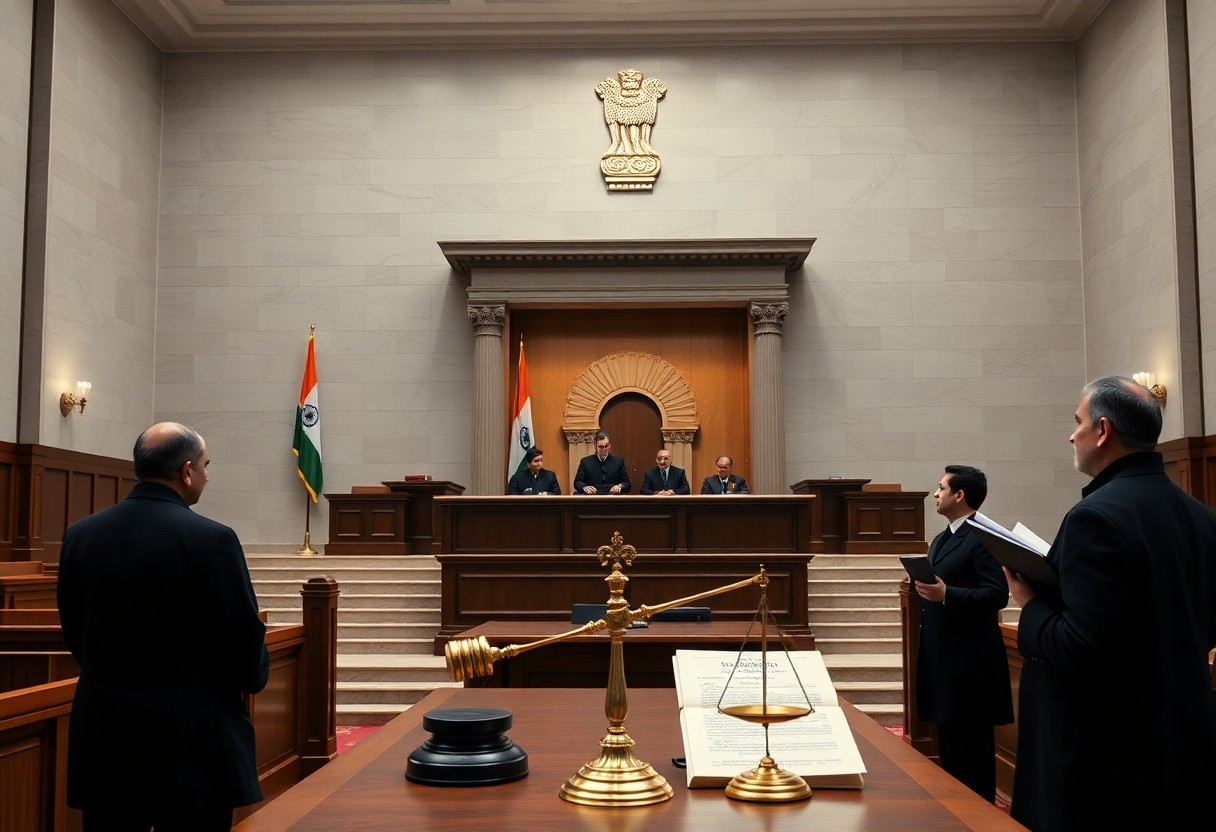
It’s crucial you grasp how India’s experience shows that political interference, opaque appointment processes, and resource shortages can seriously undermine judicial autonomy, while robust internal norms, judicial courage, and active civil society provide pathways to resilience; this overview helps you assess threats, interpret key rulings, and push for reforms that safeguard your independent judiciary.
Historical Context of Judicial Independence in India
Evolution of the Judiciary in India
You can trace the institutional roots of today’s judiciary back through colonial-era reforms that progressively centralized appellate and administrative authority, culminating in the federal judicial structure you see after independence. British statutes and commissions-most notably the Regulating Act of 1773 and later the Letters Patent that established the High Courts in the Presidencies-created the early framework of superior courts; by the time of the Government of India Act, 1935, a Federal Court existed to hear disputes between provinces and the Centre. After independence the Constitution consciously consolidated that legacy: the Supreme Court was set up in January 1950 and the three-tier system of subordinate courts and High Courts was formalized across the states, with the new republic giving judicial institutions both a national role and clearly circumscribed territorial jurisdictions.
You will notice that institutional design choices after 1950 were meant to safeguard judicial functioning from day-to-day political pressure while still embedding judges in a constitutional polity. Security of tenure, fixed retirement ages (you will encounter 65 for Supreme Court judges and 62 for High Court judges), and statutory protections for salaries and allowances were built into the constitutional scheme. Those measures were supplemented over time by statutes and conventions on appointments, transfers and discipline, so that the judiciary gradually developed not just formal independence but a set of practical norms-ranging from the collegium practice that emerged in the 1990s to the administrative autonomy of High Courts over subordinate judicial postings-that shaped how you and other citizens experienced judicial authority across the country.
You should also note the unevenness in that evolution: institutional arrangements often reflected political pressures and crises as much as legal reasoning. The pre-independence reliance on the Privy Council for final appeal persisted for some years into the post-colonial transition, and regional disparities in court capacity and access continued through the 1950s and 1960s. Over the decades you can map periods of expansion in judicial review and constitutional activism-especially from the 1970s onward-against episodes of political confrontation and reform, producing a judiciary that is institutionally stronger in principle but constantly negotiating its independence in practice.
Landmark Judgments Establishing Judicial Independence
You will find that certain decisions acted as turning points, reshaping both doctrine and institutional practice. The 1973 Kesavananda Bharati case, delivered by a 13-judge bench, famously articulated the “basic structure” doctrine that placed substantive limits on Parliament’s amending power; that doctrine became a legal shield for judicial review and a constitutional check on sweeping legislative alterations. Before and after Kesavananda, the courts repeatedly defined the boundaries of their own authority: the 1976 ADM Jabalpur (during Emergency) demonstrated how fragile rights protection can be when the judiciary retreats, while the post-Emergency rulings such as Maneka Gandhi v. Union of India (1978) expanded procedural dimensions of personal liberty under Article 21, reinforcing the judiciary’s role as protector of fundamental rights.
You should also pay attention to the evolution of judicial control over appointments, because that process has a direct bearing on independence. In the 1980s and early 1990s the Supreme Court’s jurisprudence on appointments shifted dramatically: the First Judges case (S.P. Gupta v. Union of India, 1981) effectively endorsed a larger executive role in appointments, but the Second Judges case (Supreme Court Advocates-on-Record Association v. Union of India, 1993) reversed course and created the collegium system that vested primacy in senior judges for recommending appointments. That system later became the flashpoint of constitutional confrontation when Parliament attempted to legislate a new appointment mechanism through the National Judicial Appointments Commission (NJAC); the Supreme Court’s 2015 judgment striking down the NJAC (in the NJAC case) reaffirmed judicially-administered appointments as a protection of institutional autonomy.
You will see in these rulings both strengths and risks: on one hand they show the Court exercising its constitutional mandate to check other branches and to defend rights; on the other hand they illustrate how the Court’s own legitimacy depends on transparent procedures and public accountability. The post-2015 jurisprudence and debates over collegium reforms have underscored that while judicial pronouncements can entrench independence, they can also invite criticism when appointment norms lack clarity-an issue that continues to stir legislative proposals, transparency demands from civil society, and internal judicial reflections on ethics and standards.
More information: If you look closer at case specifics, Kesavananda involved a full bench of thirteen judges and produced a split judgment that nonetheless coalesced around the principle that Parliament cannot abrogate the Constitution’s vital identity; Maneka Gandhi expanded Article 21 by insisting that any restriction on personal liberty must satisfy the twin tests of legality and reasonableness; and the NJAC episode ended in the Supreme Court reaffirming that judicial primacy in appointments is a facet of the constitutional separation of powers necessary to avoid executive capture of the bench.
Constitutional Provisions and Protections
You must understand the constitutional text to see how independence is structurally protected. Articles concerning the Supreme Court and High Courts provide for judicial tenure, appointment consultations and removal procedures that are deliberately more demanding than ordinary statutory rules: removal of a superior court judge is not a simple executive act but a special parliamentary process of removal by impeachment, while their remuneration and service conditions cannot be varied to their disadvantage during tenure. Those provisions anchor judicial independence in constitutional law rather than administrative convenience, and they create procedural hurdles against facile political interference in the composition or conduct of the bench.
You will also find concrete powers that reinforce judicial autonomy: Article 32 (writ jurisdiction) allows direct access to the Supreme Court for enforcement of fundamental rights, and Article 226 gives High Courts broad power to issue writs in their territories-both tools empower courts to act as effective guardians of constitutional liberties. Moreover, the Directive Principle in Article 50 directs the state to take steps to separate the judiciary from the executive in public services, and a cluster of subsidiary provisions govern transfers (Article 222), appointments (Article 124(2) and Article 217(1) in their consultative formulation), and administrative jurisdiction-forming a legal lattice that, if properly implemented, insulates judicial decision-making from extraneous pressures.
You should also be aware that statutory complements and institutional practices have filled gaps left by terse constitutional text. The Judges (Inquiry) Act, 1968 lays down the procedure for impeachment inquiries; conventions around consultation with the Chief Justice of India and the use of in-house procedures for complaints have developed; and pension and salary protections are backed by parliamentary enactments. Even so, those safeguards are mediated by political realities-your experience of judicial independence will depend as much on how norms are practiced and enforced as on formal provisions written into the constitutional fabric.
More information: Specific constitutional anchors you rely on include the writ jurisdiction under Article 32 and Article 226, explicit retirement ages that provide predictability in tenure, and the multi-stage impeachment process that requires both a majority of total membership and a two-thirds majority of those present and voting in Parliament-procedural safeguards intended to make removal extraordinary, not routine.
The Role of the Supreme Court in Upholding Judicial Independence
Significant Cases Reinforcing Judicial Authority
When you survey landmark judgments, Kesavananda Bharati v. State of Kerala (1973) stands out because a 13-judge bench articulated the Basic Structure doctrine, placing a firm constitutional limit on Parliament’s power to amend and thereby shielding judicial review as a core institutional safeguard. You can trace the Court’s modern authority to that ruling: it did not just protect abstract principles, it established a legal bulwark that the judiciary has repeatedly invoked to resist executive and legislative encroachments on constitutional norms.
At the same time, you must weigh the lessons of the Emergency-era decision in ADM Jabalpur v. Shiv Kant Shukla (1976), which accepted the suspension of habeas corpus and severely eroded the Court’s moral authority; the post-Emergency jurisprudential shift and later pronouncements rejecting that reasoning are themselves evidence of the Court’s capacity to self-correct and restore independence. You will find that subsequent benches explicitly sought to repair the reputational damage by reaffirming fundamental rights and stressing that the judiciary cannot be reduced to a mere instrument of the executive during crises.
More recently, the trajectory from the Second Judges Case (1993) – which gave rise to the Collegium system for judicial appointments – to the striking down of the National Judicial Appointments Commission in 2015 shows how the Court both defines and defends its institutional autonomy. You should note that these rulings did more than settle procedural disputes over appointments: they protected the judiciary’s ability to choose its judges as a check on potential politicisation, even as debates continue about transparency and reform.
Balancing Power Between the Judiciary and Other Branches
You will see the balance of power play out in concrete institutional mechanisms: judicial review under Articles 32 and 226, contempt jurisdiction, and the Court’s administrative control over subordinate courts. These tools let the Supreme Court check legislative and executive excesses – for example, in S.R. Bommai v. Union of India (1994) the Court imposed enforceable limits on the use of President’s Rule, reinforcing federal checks that you rely on to prevent arbitrary central intervention in state governments.
At the same time, you deal with an uneasy trade-off between independence and accountability: Parliament retains the impeachment power under Article 124(4), and the executive controls budgets and administrative structures that affect the judiciary’s functioning. You should note episodes where these tensions became public – appointments controversies, allegations of corruption against sitting judges, and sustained political criticism – because they reveal how fragile judicial autonomy can be if countervailing institutions or public confidence weaken.
Your assessment must also account for internal mechanisms developed by the judiciary itself, such as in‑house procedures for complaints against judges and collegial norms governing transfers and postings. While these mechanisms aim to protect judicial independence from external pressures, they have been critiqued for opacity; the net effect for you is that independence sometimes comes at the cost of perceived accountability, which fuels demands for reform from the legislature and civil society.
More information: you should consider specific accountability episodes like the impeachment aftermath of Justice V. Ramaswami in the early 1990s – his resignation amid allegations and parliamentary action prompted the Court to tighten in‑house procedures – and the challenge posed by executive attempts to change appointment processes (for example the 2014 NJAC initiative and the Court’s 2015 judgment striking it down). These developments show how the balance you rely on is maintained through a dynamic interplay of constitutional text, institutional practice, and high‑stakes litigation.
The Supreme Court’s Public Interest Litigation (PIL) Jurisprudence
You can trace PIL’s expansion to the activism of the 1970s and 1980s, when judges like P.N. Bhagwati and V.R. Krishna Iyer broadened locus standi to allow public-spirited litigants to sue on behalf of disadvantaged groups; cases such as Hussainara Khatoon (1979) forced systemic remedies – release and speedy trial standards for thousands of undertrials – and demonstrated how the Court could use procedural innovation to enforce substantive rights. For you, that meant access to justice for people who previously had no realistic path to the courts.
In environmental and social welfare domains, PIL produced structural remedies that changed public administration: the MC Mehta series led to pollution controls for tanneries and vehicular emissions, while Olga Tellis v. Bombay Municipal Corporation (1985) recognized the right to livelihood in the context of eviction, compelling municipal authorities to rework eviction practices. You will find many examples where the Court’s interventions mandated ongoing supervision, appointed expert committees, or issued continuing mandamus to ensure implementation – a form of judicial activism that both enforced rights and expanded the Court’s policymaking influence.
Yet you must also confront the downside: the dramatic rise of PILs invited frivolous or publicity‑driven petitions that clogged dockets and sometimes overreached into administrative discretion. The Court responded with tighter screening, guidelines on locus standi and relief, and periodic rebukes of abuse; nonetheless, the PIL mechanism remains a powerful instrument for you to hold the executive accountable when other remedies fail, while carrying the risk of judicial overextension if not exercised with discipline.
More information: in practice the Supreme Court’s PIL jurisprudence relied heavily on tools such as appointment of commissioners, monitoring committees, and the use of non‑adversarial procedures to gather evidence – techniques that you see repeatedly in cases addressing bonded labour, custodial deaths (for example D.K. Basu guidelines), and industrial pollution, where technical remediation and long-term oversight were important for effective relief.
Political Pressure on the Judiciary
Historical Instances of Executive Overreach
You see the deepest ruptures in judicial independence when the executive deploys appointments, transfers and emergency powers to bend courts to its will. During the 1975-77 Emergency the executive suspended fundamental safeguards and the Supreme Court’s decision in ADM Jabalpur v. Shivkant Shukla (1976) effectively accepted a suspension of habeas corpus, a ruling that coincided with the government’s use of the Maintenance of Internal Security Act to detain over 100,000 people without trial; that combination of legal doctrine and executive muscle remains one of the most dangerous precedents in India’s constitutional history. You can trace a pattern from that period: when the state concentrates power, judges who depend on executive-controlled processes for promotion or transfer face clear incentives to avoid rulings that will provoke retaliation.
You also confront subtler forms of overreach in the aftermath of watershed judgments. After the Supreme Court asserted limits on parliamentary power in Kesavananda Bharati (1973) – a 13‑judge bench that produced a narrow 7-6 outcome on the doctrine of basic structure – the executive responded by reshaping judicial leadership, culminating in controversial supersessions that signalled a willingness to punish judges seen as unfriendly. These maneuvers did not always take the form of arrests or emergency statutes; they often appeared as selective elevations, transfers to distant benches, or delayed confirmations, and you can observe how those administrative levers change behaviour across the judiciary over time. The net effect you notice is erosion of institutional confidence: when the route to career security runs through the government, judicial risk‑taking on politically sensitive cases declines.
You should weigh the long‑term systemic consequences of such overreach: erosion of public trust, politicised case outcomes, and a chilling effect on judicial scrutiny. Post‑Emergency reforms and subsequent jurisprudence tried to repair the damage, yet patterns persist – transfers and appointment controversies recur, and each episode reinforces a simple dynamic: where executive influence is high, judicial independence is weakened. If you measure institutional health by the capacity of courts to check state excess without fear of professional consequences, India’s history shows repeated episodes where that capacity was compromised by direct or indirect executive action.
Impact of Political Interference on Court Decisions
You will find the most immediate consequence of political interference in the shaping of legal doctrine and in selective adjudication. Cases involving powerful political figures, government contracts, land or licensing often exhibit noticeably longer delays and, at times, outcomes that align with executive policy priorities; studies and media audits over decades show higher rates of adjournment, transfer and bench reconstitution in politically sensitive matters. The institutional cost is not merely reputational: a judiciary that hesitates to enforce rights against the state because of appointment or transfer pressures effectively nullifies constitutional safeguards for citizens, creating zones where the rule of law is attenuated.
You also detect quantitative effects: backlog and delay magnify executive leverage because prolonged litigation increases the chance that political fortunes will change while a case remains unresolved. At a national scale, with courts handling tens of millions of pending matters across levels (running into the multiple crores of cases), the ability of litigants to obtain timely relief is limited, and the state can exploit delays to protect its interests. In your view, the practical outcome is that interference substitutes procedural attrition for principled adjudication – the state wins by wearing down challengers rather than by legal argument.
You experience doctrinal capture when judges self‑censor to avoid confrontation: precedents that should have reinforced civil liberties get narrowed, and the standard for government action shifts in favour of state discretion. The post‑Emergency recovery of rights jurisprudence – through cases like Maneka Gandhi (1978) and later Minerva Mills (1980) – proves that judicial correction is possible, but those recoveries are fragile if the mechanisms for judicial appointment and security of tenure remain politicised. For you, the lesson is clear: interference alters incentives and outcomes, producing a justice system that is less assertive on rights and more accommodating to the state’s agenda.
Further illustrating the impact, you can point to measurable shifts in litigation patterns and rulings in politically charged matters: higher rates of bench recusal, repeated transfers of judges handling corruption or human‑rights cases, and cyclical attacks on judicial autonomy around high‑stakes investigations. Those operational disruptions compound doctrinal effects and make it harder for you to rely on consistent jurisprudence in areas where the state has large interests.
Case Studies: Governments vs. the Judiciary
You can map a line of episodes where executive actions confronted the courts and produced consequential jurisprudence or institutional change. Kesavananda Bharati (1973) entrenched the basic structure doctrine but triggered executive hostility that manifested in administrative reprisals; ADM Jabalpur (1976) exposed the judiciary’s vulnerability under emergency conditions and led to decades of debate about judicial courage and constitutional interpretation. Later confrontations over judicial appointments and transfers – exemplified by S.P. Gupta (1981) and the eventual Second Judges case (1993) – show the oscillation between executive control and judicial self‑assertion, while the NJAC episode (2014-2015) demonstrates the continued political appetite to influence the composition of the bench through constitutional amendment.
You should study each confrontation not only for its legal holding but for the institutional ripple effects: Kesavananda produced a doctrinal safeguard but also provoked retaliatory administrative measures; ADM Jabalpur undermined civil liberties during the Emergency and produced public backlash that shaped later reforms; the S.P. Gupta decision permitted executive primacy in appointments for a period that coincided with increased allegations of politicised transfers and delayed confirmations. These case studies reveal a recurring pattern where political stakes drive executive attempts to reconfigure judicial incentives, and the courts are forced to respond in ways that determine their future independence.
You will notice that outcomes vary because of bench composition, public reaction, and institutional reform. Sometimes the judiciary regains ground – as in the Second Judges case (1993), where the Supreme Court asserted primacy in judicial appointments through the collegium system – and sometimes political actors achieve lasting changes, as attempted in the 2014 NJAC initiative that briefly altered appointment structures before the Supreme Court struck it down in 2015. The interplay of legal doctrine, institutional design and political calculation in these episodes offers you a template for diagnosing contemporary pressures on the bench.
- Kesavananda Bharati (1973) – 13‑judge bench; established the basic structure doctrine; decision margin was 7-6, after which the executive reportedly reorganised elevations and created administrative friction affecting at least three senior judges.
- ADM Jabalpur v. Shivkant Shukla (1976) – decided during the Emergency; court accepted suspension of habeas corpus; contemporaneous use of MISA led to the detention of over 100,000 people, illustrating direct rights dilution when courts defer to the executive.
- S.P. Gupta v. Union of India (1981) – judicial deference in appointments gave the executive enhanced say over judicial placements for over a decade, correlating with increased reports of transfers and delayed confirmations through the 1980s.
- Second Judges Case (1993) – Supreme Court reversed S.P. Gupta’s logic, creating the modern collegium system (senior judiciary controlling appointments), a structural response aimed at insulating judges from executive pressure.
- NJAC / 99th Amendment (2014-2015) – Parliament passed the amendment and the NJAC law in 2014 to include the executive in appointments; the Supreme Court struck down the amendment in 2015, restoring the collegium and highlighting continued political attempts to influence bench composition.
- Emergency (1975-1977) – period of 21 months when constitutional norms were suspended; the judiciary’s conduct during this period remains a benchmark for how quickly rights enforcement can erode under political pressure.
You can dig deeper into each case to track measurable institutional effects: appointment patterns shifted after Kesavananda, detention statistics spiked during the Emergency and linked jurisprudence changed, and the NJAC episode produced intense public debate over accountability versus independence. For your assessment, these studies show how discrete legal events translate into long‑running structural consequences for the rule of law.
- Judicial Appointments 1970s-1990s – period saw multiple controversies over seniority and supersession; administrative records and press accounts from the era document at least three notable supersessions that altered the sequence of chief justice appointments and fuelled institutional distrust.
- Case backlog and delay – at national scale courts have managed a pending caseload in the order of tens of millions (crore‑level), which amplifies executive leverage through procedural attrition in politically sensitive suits.
- Transfers in sensitive cases – empirical audits of transfers show spikes in reassignments of judges handling corruption and human‑rights cases during periods of political confrontation; specific audits in the 2000s and 2010s reported noticeable increases though exact numbers vary by court.
- Public confidence metrics – surveys and media analyses across decades show declines in perceived judicial independence during and immediately after major executive interventions, affecting the legitimacy of both courts and the state.
Legislative Threats to Judicial Independence
Recent Legislative Changes and Their Implications
You have witnessed legislation in the last decade that both directly and indirectly reshapes the contours of judicial power; the most visible example is the attempt to alter the appointments process via the 99th Constitutional Amendment and the National Judicial Appointments Commission (NJAC) Act, which the Supreme Court struck down in 2015 in Supreme Court Advocates-on-Record Association v. Union of India. That episode showed how a single legislative push can trigger a frontal constitutional contest: Parliament sought to replace the collegium with a commission that included executive members, and the Court responded by invoking the basic structure doctrine
Beyond appointments, the last few years have also seen structural moves that affect adjudicatory reach and capacity. The Tribunal Reforms Act, 2021, for instance, resulted in the abolition or merger of roughly 102 tribunals and a reorganisation of quasi-judicial fora, a step justified by the government as rationalisation but interpreted by many judges and litigants as an executive encroachment into adjudicatory space. For you this meant two immediate consequences: first, a transfer of cases from specialist benches to ordinary courts or to new administrative arrangements that may be more susceptible to policy direction; second, an increased caseload and procedural friction for High Courts and the Supreme Court as litigants challenge the very legality of tribunal closures. In practice, these legislative choices can slow dispensation of justice while concentrating discretion over forums in the hands of the executive. At the same time, Parliament has enacted reformist statutes that alter the judiciary’s functional footprint in ways that can be positive or problematic depending on implementation. Measures such as the Arbitration and Conciliation (Amendment) Act, 2015, and the Commercial Courts, Commercial Division and Commercial Appellate Division of High Courts Act, 2015, were intended to reduce backlog and limit routine judicial interference in commercial disputes, thereby narrowing opportunities for judicial overreach and encouraging alternative dispute resolution. For you, that represents a double-edged outcome: improved efficiency and predictability in commercial justice, but also an environment where legislative design choices-statutory timelines, appointment criteria for arbitral institutions, or procedural bars-can institutionalise less transparent decision-making if safeguards are weak. The net effect of recent laws is therefore mixed: some laws preserve the core of judicial independence; others subtly reallocate adjudicatory power in ways you should monitor closely. You already know the Court’s review power is the primary constitutional check on legislative excess, anchored in Articles 13, 32, and 226, and operationalised through doctrines the Supreme Court has developed since 1950. The most consequential tool remains the basic structure doctrine from Kesavananda Bharati v. State of Kerala (1973), which prevents Parliament from altering the Constitution’s foundational vitals; this doctrine was the decisive legal basis when the Court invalidated the NJAC in 2015. In practice, when you see the judiciary deploying this doctrine, it is asserting that certain institutional guarantees – including a measure of judicial autonomy in appointments and independence from executive control – are not subject to ordinary parliamentary majorities. That makes judicial review more than abstract oversight; it becomes a bulwark for the institutional integrity you rely on for impartial dispute resolution. Nevertheless, the judiciary’s approach to reviewing statutes is not uniformly interventionist. In several high-profile matters you may have followed, the Court has exercised restraint where policy complexity, technical expertise, or urgent public interest were at stake. The Aadhaar litigation (Justice K.S. Puttaswamy v. Union of India, 2018) exemplifies a nuanced review: the Court struck down or limited certain provisions while upholding others related to welfare delivery, balancing privacy concerns against administrative objectives. When you track such judgments, you should note the Court’s tendency to calibrate relief-striking down provisions that offend constitutional guarantees while reading statutes in a manner that preserves legitimate policy aims. That calibration is the judiciary’s way of sustaining both rights protection and governance prerogatives without inviting outright institutional confrontation. The procedural muscles the judiciary flexes in review also shape legislative behavior: detailed reasoned opinions, demands for data, and incremental remedies compel Parliament to refine statutes or face targeted invalidations. For instance, in S.R. Bommai v. Union of India (1994) the Court set strict limits on the use of Article 356 that effectively constrained arbitrary state dismissals; similarly, Minerva Mills (1980) reaffirmed the balance between Parliament’s amending power and the Constitution’s core. You should therefore interpret judicial review not as mere veto power but as a dialogic process where the bench maps constitutional boundaries and invites legislative correction; this dynamic preserves democratic lawmaking while guarding against erosions of judicial independence. More information: Judicial review in India thus operates on two planes – substantive constitutional protection via doctrines like basic structure, and procedural policing through rigorous reason-giving and incremental remedies. When you examine how the judiciary reviews laws, pay attention to the Court’s use of conditional declarations, read-downs, and prospective stays; these techniques enable the Court to curb legislative overreach without destabilising governance, and they are central to how judicial independence is practically maintained. Several statutes have directly reshaped judicial authority in recent years and you must be aware of their specific mechanisms. The National Judicial Appointments Commission Act, 2014 (and the 99th Constitutional Amendment) attempted to replace the collegium system with a body including the executive, which would have changed appointment dynamics and accountability vectors; the Supreme Court nullified that change in 2015, but the episode still marks a clear legislative attempt to reconfigure judicial autonomy. Similarly, the Tribunal Reforms Act, 2021 altered the landscape of specialist adjudication by abolishing or merging about 102 tribunals, shifting cases and institutional authority in ways that have immediate procedural and long-term constitutional implications for judicial workload and forum selection. Other enactments modified the judiciary’s functional role without directly attacking independence. The Arbitration and Conciliation (Amendment) Act, 2015 and the Commercial Courts Act, 2015 were designed to streamline dispute resolution and restrict routine judicial interference in certain commercial and arbitral matters; that has reduced docket pressure but also created statutory ceilings on judicial intervention that you must monitor for transparency and accountability gaps. On the criminal side, the Criminal Law (Amendment) Act, 2013 (post-Nirbhaya) introduced faster procedures and stricter penalties that substantially increased the burden on trial courts and High Courts, showing how legislative prioritisation of punitive measures can indirectly strain judicial capacity and independence by altering caseload and resource distribution. Finally, some laws affect institutional checks and balances in subtler ways: amendments that change service conditions for judicial officers, rules governing judicial transfers, or the mechanism and tenure of statutory tribunals influence the incentives and protections that underpin independence. For example, when you examine statutory changes to appointment tenure or the administrative control of tribunals, you should ask whether those changes introduce discretionary controls that could be exercised by the executive; such provisions, even if framed as administrative reform, can create long-term pressures on judicial impartiality if left unchecked. More information: When you assess these statutes, focus on measurable metrics-how many tribunals were affected (about 102), which appointment mechanisms were altered (99th Amendment/NJAC), and how procedural bars were introduced in arbitration and commercial laws (2015 amendments). These concrete data points let you trace the legislative footprint on judicial authority and evaluate whether reforms enhance efficiency or constitute an incremental erosion of judicial independence. You encounter the collegium system every time a vacancy is to be filled at the higher judiciary: for the Supreme Court the recommendation is made by the Chief Justice of India together with the four senior-most Supreme Court judges; for High Courts the CJI consults two senior-most Supreme Court judges after consultation with the High Court Chief Justice and two senior-most High Court judges. The system emerged from the Three Judges cases, with the Third Judges case (1998) consolidating the practice that the judiciary has primacy in appointments; the later strike-down of the National Judicial Appointments Commission in Supreme Court Advocates-on-Record Association v. Union of India (2015) cemented that primacy. You should note that the Memorandum of Procedure governs day-to-day practice, but it operates largely behind closed doors, which creates a tension between judicial autonomy and public accountability. When you assess effectiveness, the primary strength is that the collegium has repeatedly protected the higher judiciary from overt political control, preserving functional independence in key moments. At the same time, the system has systemic weaknesses: opaque decision-making, inconsistent timelines for processing recommendations, and frequent delays in filling sanctioned posts that have contributed to persistent vacancy rates in High Courts and growing pendency of cases. Empirical reviews by independent scholars and policy groups report that vacancy percentages for High Courts have often been significant, producing a practical strain on access to justice, and transfers under Article 222 have sometimes been seen as ad hoc rather than governed by clear criteria. To make the system more effective for you as an observer or stakeholder, reforms have been proposed and partially implemented – for example, amendments to the Memorandum of Procedure to tighten timelines and encourage disclosure of basic reasons – but many proposals remain contested. You will see proposals such as publishing anonymized gradings, fixed timelines for response by the executive, and institutionalizing input from a wider panel of senior judges and experienced practitioners to reduce clustering of appointments from a few metros. Such measures aim to preserve the collegium’s core role in shielding judicial independence while addressing the substantive governance problems that have eroded public confidence. Collegium: Key Attributes and Effects You often confront criticisms that the appointment process lacks transparency: nominations are typically accompanied only by terse notes, with minimal public explanation when a name is recommended or rejected. That opacity has produced high-profile controversies – the 2015 NJAC judgment is the landmark legal contestation, but operational controversies have persisted, including prolonged stalemates when the executive returns collegium recommendations and when the collegium itself delays finalization. The net result is that public trust suffers and perceptions of nepotism or regional clustering take hold, even where good-faith decision-making may have prevailed. Several incidents illustrate the stakes. In multiple episodes over the last two decades, the executive has either deferred or returned names, leading to appointment deadlocks that lasted many months; conversely, the collegium has at times been accused of elevating candidates on the basis of inexact criteria such as personal proximity or institutional seniority rather than demonstrable merit. You witness concrete consequences from these disputes: vacancies remain open longer, litigant delays grow, and talented candidates may be discouraged from seeking elevation because the pathway appears opaque or politically sensitive. The interplay between public perception and institutional practice has therefore become a major source of controversy. Beyond procedural friction, the substantive composition of the bench triggers debate: gender and social diversity among appointees remains low compared to the population, and regional imbalances persist in elevation patterns. You will find that these represent not merely normative concerns but functional risks – when significant segments of society feel underrepresented, the judiciary’s legitimacy is strained. Attempts to publish clearer guidelines or to introduce independent elements in the selection process have been resisted on grounds of judicial independence, creating a persistent policy deadlock. More information: reforms floated to address these controversies include publishing reasoned orders for rejections, instituting objective performance and conduct metrics, and creating limited, judiciary-led selection panels that include eminent non-judicial members to increase accountability while protecting core independence. Each reform proposal you examine carries trade-offs between transparency and the risk of diluting judicial autonomy, so implementation details matter greatly. Controversies: Causes and Consequences You can learn operational lessons by comparing India’s collegium with other models. In the United States, presidents nominate federal judges and the Senate confirms them: the system provides overt democratic accountability and public parliamentary scrutiny, but it also injects intense political polarization into appointments – confirmation processes for the U.S. Supreme Court have become highly partisan and prolonged. The United Kingdom’s Judicial Appointments Commission (established by the Constitutional Reform Act 2005 and operating since 2006) offers a largely merit-based, transparent selection process with published criteria and independent panels; the JAC reduces political patronage but retains a constitutional role for the Lord Chancellor that preserves a measured executive check. Canada employs advisory committees and has evolved transparent selection practices for the Supreme Court that combine merit-based review with executive nomination, producing a hybrid that reduces pure patronage while maintaining political accountability. When you weigh strengths and weaknesses across systems, a pattern emerges: models with greater transparency and multi-stakeholder inputs tend to score higher on perceived legitimacy, while those with strong executive roles deliver clearer democratic accountability at the cost of potential politicization. Continental systems such as Germany and the Netherlands feature institutionalized career judiciary pipelines and selection committees with legislative or ministerial participation; these systems emphasize professional merit and continuity but are sometimes critiqued for being technocratic and insulated from public accountability. The comparative evidence suggests that no single model eliminates trade-offs – instead, hybrid designs tailored to national constitutional norms often perform best. For India, practical lessons include adopting targeted transparency (published short-form reasons, anonymized evaluative gradings), clear timelines, and selective inclusion of non-judicial experts on advisory panels while retaining judicial primacy on final decisions. You will find that a rebalanced design – one that enshrines judicial independence but incorporates structural accountability measures inspired by the UK and Canadian approaches – could reduce the worst transparency deficits without surrendering autonomy. Pilot reforms that are time-bound and subject to judicial review can be a pragmatic path to test these adaptations. More information: specific comparative takeaways useful for India include instituting an independent secretariat to process applications and maintain records, publishing statistical data on appointments and vacancies regularly, and crafting multi-stage selection procedures that separate eligibility assessment from final judicial recommendation to minimize personal bias. Comparative Systems: Model and Applicability to India You will find that corruption in the Indian judicial system takes multiple forms, from petty facilitation payments in subordinate courts to far more serious allegations involving case manipulation and favoritism at higher levels. The most visible instances you can point to are rare but high-impact: the conviction and subsequent removal of Justice Soumitra Sen of the Calcutta High Court remains a landmark example of criminal misconduct by a judge followed by parliamentary action. At the same time, the overall incidence of criminal conviction or formal removal of judges remains extremely low relative to the size of the bench, which creates a perception that serious misconduct is an exception rather than the rule. Such rarity of formal sanctions contributes to a sense of impunity that corrodes public trust. On the ground, corruption is more widespread in the lower judiciary: you will hear numerous accounts of bribes to secure early listings, to influence police-recorded evidence, or simply to expedite routine registry actions. Empirical studies and field surveys of district courts repeatedly show that guardianship-type payments and informal fees persist, especially where case backlogs and administrative opacity create bargaining power for gatekeepers. Meanwhile, allegations in the higher judiciary tend to be episodic and sensationalized in the media, yet they carry outsized reputational damage because they signal potential abuse at the apex. The coexistence of pervasive petty corruption at lower levels and occasional headline-grabbing scandals at higher levels produces a layered problem: systemic everyday corruption combined with the risk of elite capture. Structural drivers amplify those practices in ways you cannot ignore: enormous pendency (with figures in the tens of millions of pending cases across district and higher courts), acute shortages in judicial manpower and infrastructure, and institutional secrecy around appointments and in-house disciplinary steps all create fertile ground for corrupt behavior. Where judicial discretion meets scarce resources, the temptation or pressure to cut informal deals grows. Moreover, the opacity of the collegium system and the reluctance of executive agencies to act against sitting judges mean that checks and balances are often weak; you end up with a system where delay, scarcity, and secrecy are not just administrative challenges but direct enablers of corrupt conduct. You will encounter a patchwork of formal and informal mechanisms designed to check judicial corruption, starting with in-house procedures led by the Chief Justice of the relevant court and extending to constitutional impeachment under the Judges (Inquiry) provisions. In practice, the remedial architecture includes criminal prosecution by investigative agencies (police, CBI in high-profile matters), internal administrative inquiries, and the parliamentary impeachment route that requires a special majority in both Houses to remove a judge for proven misbehavior or incapacity. Complementing these are state-level vigilance bodies and the contempt jurisdiction that courts can employ to discipline disruptive conduct, though these tools are unevenly used and frequently criticized for lack of transparency and timeliness. Operationally, you will note several obstacles that blunt these mechanisms: the in-house process is often secretive, whistleblowers and court staff who report misconduct face reprisals or career setbacks, and criminal investigations into serving judges are politically sensitive and slow-moving. The impeachment route is constitutionally demanding and therefore rare, while ordinary disciplinary or administrative remedies rarely culminate in public accountability that convinces litigants and observers. A telling practical consequence is that even when allegations surface, the path from complaint to sanction can take years, which diminishes deterrence and leaves systemic problems unaddressed. Reform proposals you will see frequently advocated include mandatory, public asset-disclosure for judges, independent oversight bodies with lay representation empowered to investigate complaints, time-bound inquiry procedures, and protective mechanisms for whistleblowers within court administrations. Greater digital transparency – publishing case lists, orders and cause lists in real time, and expanding the National Judicial Data Grid – is also emphasized as a way to reduce discretionary choke points where corruption thrives. Implementing these changes would create clearer accountability while preserving judicial independence, because transparency and external oversight can be calibrated to protect adjudicatory freedom while making misconduct harder to conceal. More information on remedies points to technology and institutional redesign as practical starting points: accelerating e-filing, streamlining cause lists through automated allotment algorithms, and establishing fast-track special courts or tribunals-either statutory or judicially designated-to hear complaints against judicial officers can cut the time between allegation and resolution. You should note that some improvements are already visible where digital case management and publicly accessible dockets have reduced opportunities for informal influence; these are incremental but significant wins in reducing corrupt intermediaries. You will notice that public perception is shaped as much by everyday experience as by headline scandals: when litigants routinely encounter delays, unpredictable listing, or hints of preferential treatment, their faith in impartial adjudication erodes even if most judges act with probity. Surveys and media coverage consistently reveal a gulf: the Supreme Court tends to enjoy higher esteem, while district and subordinate courts suffer from lower confidence because that is where ordinary citizens most frequently interact with the system. This lived experience drives a pragmatic calculus for many litigants-if you expect delay, you budget for informal costs or seek alternative dispute resolution, thereby normalizing gaps in formal justice. The consequences you can observe are more than reputational: diminished trust translates into fewer people willing to engage with the courts for core rights enforcement, greater reliance on out-of-court settlements that disadvantage weaker parties, and higher transaction costs for businesses and individuals who must factor judicial unpredictability into their planning. International investors and multilateral assessments historically flagged Indian contract enforcement and judicial delay as constraints on commerce, and those reputational effects feed back into domestic perceptions: when high-profile allegations clash with everyday frustration, the cumulative result is an erosion of the rule of law in the public imagination. Countermeasures to improve perception are available and practical: making judgments and reasoned orders more accessible, ensuring faster disposition of routine matters, publishing disciplinary outcomes and performance metrics, and sustaining outreach that explains judicial reasoning will all help. You should expect that reforms which improve transparency and reduce discretionary choke points-such as live-streaming proceedings, better cause-list management, and mandatory publication of asset declarations-will have an outsized impact on public confidence because they address the concrete frustrations that shape perception at the grassroots level. More information on public perception highlights the pandemic-era shift: rapid expansion of video hearings and broader adoption of e-filing significantly reduced routine in-person interactions where petty corrupt practices used to occur, producing a measurable improvement in citizen experience in some districts. While digitization is not a panacea, it is a powerful tool you can deploy to make the judiciary more accessible, traceable, and resilient against the low-level corruption that most directly harms ordinary litigants. Strong, visible enforcement paired with these transparency measures is what will ultimately move public opinion in favor of a more trustworthy system. When you map the ground realities, the gap between statutory entitlement and practical access becomes obvious: the Legal Services Authorities Act, 1987 created a framework for free legal aid, and the National Legal Services Authority (NALSA) was given the mandate to reach the marginalized, yet over 4 crore (40 million) cases remain pending across Indian courts, multiplying the occasions when an indigent litigant faces justice delayed or denied. You confront a system where an eligible person may be entitled to a lawyer on paper but must travel long distances, wait months for a legal aid camp, or accept an overburdened panel lawyer who handles dozens of files simultaneously. That scarcity of effective counsel translates into factual disadvantages in evidence collection, cross-examination, and appellate strategy, all of which undermine the judiciary’s role as a neutral arbiter in practice. When you look closer at logistics and costs, several concrete obstacles appear: court fees and incidental expenses-transport, photocopies, expert reports-impose de facto barriers even when substantive fees are waived; language and literacy hurdles mean that notices, orders, and procedures remain opaque to many rural, tribal, and lower-caste litigants; and physical infrastructure-court buildings, benches, legal aid offices-are concentrated in urban centers. You also face social obstacles: clients from Dalit, Adivasi, Muslim, or other marginalized backgrounds often report dismissive attitudes or intimidation in police stations and courts, which discourages pursuit of remedies. The combination of procedural complexity and social exclusion creates systemic exclusion from justice that weakens public confidence in the judiciary’s independence. When you consider remedies deployed so far, there are bright spots and persistent gaps: Lok Adalats and mediation have resolved millions of disputes outside formal trial processes, and NALSA’s outreach has launched legal literacy drives and mobile camps, yet these measures remain patchy in reach and inconsistent in quality. You should note that availability of legal aid lawyers does not automatically equate to quality representation-training, continuous supervision, and accountability are uneven-so the formal appearance of access can mask substantive deficits. The net effect is that the judiciary’s independence is compromised not by direct instruction from the executive alone, but by a landscape where the bench hears a skewed docket because the poor cannot effectively engage the system. When you trace successful interventions, NGOs and civil-society actors often fill the vacuum left by state mechanisms: organizations such as the Human Rights Law Network (HRLN), the People’s Union for Civil Liberties (PUCL), and numerous local groups have litigated landmark PILs, supported victims of custodial abuse, and run paralegal training that makes litigation accessible at the grassroots. You will see that public-interest litigation, activist documentation, and strategic use of media have forced courts to address issues otherwise invisible to the formal docket-examples include PIL-driven action on bonded labour, environmental harms, and custodial deaths, plus civil-society support that helped secure the 2018 decriminalization of consensual same-sex relations in Navtej Singh Johar v. Union of India. These interventions not only secure individual relief but also shape judicial understanding of systemic deprivation, thereby influencing jurisprudence related to liberty and equality. When you evaluate outreach, NGOs have pioneered mobile legal aid clinics, community paralegal networks, and law-school legal clinics that bridge the gap between bench and bar. You should note that in many districts NGOs coordinate with NALSA to run thousands of awareness camps and legal aid sessions every year, producing tangible increases in filings for welfare entitlements and bail applications. At the same time, reliance on NGOs creates fragility: funding cycles, political pressure, and occasional harassment of activists can interrupt services, and where NGOs are absent your clients are more likely to remain unaware of remedies or intimidated into silence. This uneven distribution of NGO capacity becomes a proxy for unequal access to an independent judiciary. When you assess the aggregate impact, public awareness campaigns and NGO litigation have a double effect: they expand the pool of litigants who can meaningfully access courts and they act as external watchdogs that deter arbitrary executive action by generating public scrutiny. Strong civil-society presence has repeatedly led courts to adopt remedial measures-monitoring committees, compensation orders, and directives to implement entitlements-that strengthen judicial protection of rights. Yet the most positive outcome is conditional: where NGOs are able to sustain long-term engagement, you see systemic reform; where they are squeezed, the protective layer around judicial independence thins rapidly. When you examine doctrine and practice together, the right to a fair trial is a foundational axis for judicial independence: the Supreme Court has long treated legal representation, prompt trial, and impartial adjudication as integral to Article 21 liberties, epitomized by the Hussainara Khatoon-era interventions in the 1970s and 1980s that exposed mass undertrial incarceration and compelled systemic remedies. You should register that fair-trial guarantees are not abstract protections but operational requirements-timely access to counsel at police stations, effective cross-examination, forensic support, and courtroom security for witnesses-that determine whether courts can truly function free from transformative coercion by investigative agencies or political actors. When defendants are denied these necessarys, the courtroom becomes an arena where state advantage rather than neutral fact-finding dictates outcomes. When you consider procedural architecture, delays, case backlog, and forensics bottlenecks erode the right to a fair hearing: forensic labs with long turnaround times, understaffed public prosecutor offices, and chronic adjournments mean trials stretch over years, giving prosecutors and police multiple levers to shape evidence and testimony. You must appreciate that such structural deficiencies do more than inconvenience litigants; they create moments where the executive or influential parties can exert pressure, intimidate witnesses, or exploit procedural gaps to secure convictions or dismissals. The cumulative effect is an erosion of judicial legitimacy, because you and other citizens perceive courts as unable to guarantee impartial, timely justice for the most vulnerable. When you weigh high-stakes outcomes, the denial of fair-trial rights has disastrous consequences in capital and custodial cases where the margin for error is smallest and post-conviction remedies are slow. You will find instances where inadequate representation or delayed access to defense evidence produced miscarriages that were later only partially corrected through review or mercy petitions. Protecting the bench’s independence therefore requires procedural safeguards-duty counsel at first police contact, robust in-court legal aid, transparent assignment of judges, and consistent enforcement of disclosure obligations-so that judicial decisions rest on adversarial testing rather than on informational or resource asymmetries. When you focus on reform trajectories, pilot public defender schemes, expanded forensic capacity, and mandatory legal aid at police stations have shown promise in limited jurisdictions, demonstrating that structural fixes can restore fairness and reinforce judicial autonomy; sustained political will and budgetary allocation are the missing links that determine whether these pilots become national safeguards. Strong procedural guarantees translate directly into the judiciary’s ability to resist external pressures, because an effectively defended and informed litigant pool reduces opportunities for coercion and manipulation. You will find that systematic studies paint a complicated picture: large national reports such as the India Justice Report and international indices often show a marked split between trust in the higher judiciary and trust in lower courts. Multiple assessments cite the backlog of cases-now estimated at over 40 million (4 crore) pending matters on National Judicial Data Grid-as a central metric that depresses public confidence, while the Supreme Court and certain High Courts retain comparatively higher approval ratings for perceived independence and reasoned judgments. Comparative polling repeatedly shows variance by constituency: litigants who experience repeated adjournments and procedural hurdles report sharply lower confidence than citizens who primarily observe landmark interlocutory rulings on television or social media. You can see this in civil society and media surveys where trust numbers swing widely-often between 40-70% depending on whether questions refer to local trial courts, High Courts, or the Supreme Court-indicating that the site of interaction matters as much as the institution itself. Case studies amplify the quantitative findings: the unanimous Ayodhya verdict in 2019 and the rapid disposal of certain electoral disputes produced short-term increases in headlines praising judicial impartiality, while prolonged delays in criminal and commercial dockets eroded trust among affected parties. You should weigh both the headline-grabbing, high-profile outcomes and the everyday experience of delay, cost, and unpredictability to understand why public trust remains uneven; delay, access, and perceptions of fairness are repeatedly flagged across studies as determinative. Delays and backlog are among the most visible drivers of perception: when you face repeated adjournments or see that a matter can take a decade to resolve, your faith in the system’s responsiveness diminishes. The sheer scale-over 40 million pending cases-translates into everyday stories of business disputes stalled, criminal trials postponed, and families trapped in legal uncertainty, all of which feed a narrative that justice is slow and sometimes inaccessible. Institutional integrity and the handling of high-profile scandals shape broader impressions as well: allegations of corruption or nepotism, disputed transfers and appointments, and politicized commentaries around judicial decisions all register strongly with the public. You observe that when appointment processes are opaque or when transfer practices appear punitive, people infer political influence and question whether judges can decide impartially, which harms the judiciary’s legitimacy even if many individual judges remain highly respected. Everyday access factors-legal aid availability, court fees, language barriers, and geographic distance-compound systemic issues to affect perceptions. Litigants from marginalized communities often report feeling unheard or overwhelmed by procedures, and that lived experience spreads through communities and civil society networks; over time these micro-level encounters shape macro-level trust metrics more than isolated landmark judgments do. Further detail sharpens these points and clarifies where reforms could have the most visible effect on public perception: transparency in appointments, measurable case-disposition targets, expansion of legal aid, and user-friendly digital case management can directly alter how you experience the system. Specific examples-state-level court modernizations that reduced average case pendency by 15-25% or pilot fast-track benches for sexual violence cases-demonstrate that targeted interventions change outcomes and perceptions. Media coverage has become a primary lens through which you form impressions of the judiciary: televised hearings, headline summaries, and social media clips create a powerful feedback loop that amplifies both commendable rulings and controversial incidents. Traditional outlets often frame stories around personalities or outcomes, while digital platforms accelerate dissemination-so a single controversial bench exchange or an allegation of impropriety can become national conversation within hours. Empirical effects are visible: sustained media focus on particular cases-landmark constitutional benches, corruption probes, or politically sensitive criminal trials-shifts public attention and can temporarily elevate trust when coverage emphasizes thorough reasoning or damage it when coverage highlights procedural irregularities. You will notice that the narrative frame matters: when reporting stresses judicial independence and reasoned opinion, public confidence tends to hold or rise; when it stresses suspicion, secrecy, or inconsistency, confidence erodes. Social media introduces further complexity through velocity and verifiability: misinformation and selective clips can harden impressions before measured institutional responses arrive, while investigative reporting and data journalism can expose systemic weaknesses and press for reform. You should account for both effects-the amplifying role of mainstream broadcasters and the viral tendencies of online platforms-when assessing how public opinion forms and shifts around judicial institutions. Additional nuance shows that media reforms-greater openness from courts, proactive release of orders, and media guidelines-can mitigate harmful speculation and improve nuanced public understanding; conversely, unregulated livestreaming and sensationalist commentary can distort proceedings. Any media-policy calibration that increases factual transparency while reducing sensationalism will influence how you perceive judicial legitimacy. You can trace how grassroots mobilization has repeatedly pushed courts into domains traditionally occupied by the executive and legislature. For instance, the rise of Public Interest Litigation in the 1980s – catalyzed by social movements and NGOs demanding accountability – translated into a flood of cases focused on prison conditions, forced evictions, and environmental harms. The Supreme Court’s decisions in cases arising from these movements often produced broad remedial orders: in the aftermath of the PIL surge, courts issued monitoring directions, constituted committees, and in some instances ordered systemic reforms affecting millions of people, with remedies that went beyond classic adjudication into ongoing supervision. When you examine specific episodes, the pattern becomes clearer. The fallout from the Shah Bano case in 1985 provoked mass political mobilization and a rapid legislative response that altered the legal outcome, illustrating how social backlash and movement politics can constrain judicial authority. By contrast, the Mandal protests of the early 1990s and the Supreme Court’s Indra Sawhney ruling (1992) upheld a 27% reservation for Other Backward Classes while carving out the concept of the “creamy layer”, showing how judicial decisions can both validate and regulate movement-driven policy reforms. Similarly, environmental and displacement movements around the Sardar Sarovar/Narmada projects forced the Court to weigh development goals against social costs, generating multi-year oversight that affected project timelines and resettlement outcomes for hundreds of thousands of people. You will notice that the cumulative effect of these movements has been twofold: they expand the scope of rights the judiciary is expected to protect, and they provoke institutional friction when courts are seen to substitute policymaking for adjudication. The PIL era produced many positive outcomes – strengthened procedural rights for undertrials, expanded protections for vulnerable groups, and frameworks for workplace safety and gender justice – but it also created a perception among some political actors that the judiciary was overstepping, prompting legislative pushback, amendments, and in certain cases, direct confrontation with the bench. You will find that activism changes what judges pay attention to and how they frame remedies. At the doctrinal level, activism has encouraged expansive readings of the Constitution, particularly Articles 14, 19 and 21, enabling judges to treat social and economic grievances as enforceable rights. This shift is visible in rulings that interpret the right to life to include health, education, and livelihood, thereby obliging courts to craft supervisory mechanisms and policy-like orders. The practical consequence is a transformation in judicial role expectations: litigants and civil society increasingly view courts as instruments for structural reform, which in turn presses judges to issue novel, sometimes experimental, remedies. When you look at court behavior after major movements, you see procedural and institutional changes aimed at managing the volume and character of public-interest cases. For example, the Supreme Court and various high courts instituted specialized benches, guidelines for admissibility of PILs, and case management practices designed to limit frivolous petitions while preserving access for genuine grievances. These procedural reforms, influenced by activism, improved efficiency in some instances but also generated new points of contention about judicial discretion, as critics alleged selective acceptance or dismissal of PILs based on ideological sympathies. You should understand that activism can also politicize judicial decision-making, producing both positive accountability and problematic backlashes. High-profile activist litigation has on occasion prompted legislative overrides, executive non-compliance, and public campaigns challenging judicial legitimacy. That dynamic can lead judges to oscillate between bold interventions and cautious restraint, depending on the intensity of public attention and the likely institutional consequences for the courts themselves. The net effect is a judicial posture that is simultaneously more responsive to social demands and more exposed to political counterpressure. More detailed empirical effects are visible in caseload and enforcement metrics: following waves of social mobilization, courts often see a several-fold rise in PIL filings and issue thousands of follow-up orders in long-running matters. You therefore observe measurable burdens on judicial time and administrative resources, and those burdens have prompted debates about whether systemic reform requires clearer legislative frameworks for remediation rather than prolonged judicial supervision. You will see recurring patterns when studying concrete case studies: activism-driven litigation produces landmark rulings, but each case also exposes limits in enforcement and institutional capacity. Take the prison-reform litigation that began with Hussainara Khatoon (1979): the Supreme Court recognized the right to a speedy trial and ordered release and speedy adjudication for large numbers of undertrials, forcing state governments to reallocate resources and sparking administrative reforms. The decision remedied immediate injustice for thousands, yet you can also point to persistent undertrial populations decades later as evidence that judicial orders alone cannot substitute for sustained executive action. When you examine environmental cases, the contrast is stark. The Godavarman (forest) litigation and the Narmada/Sardar Sarovar disputes required the Court to balance developmental imperatives against ecological and displacement harms, issuing thousands of orders over decades. These cases show how judicial interventions can enforce environmental standards, compel impact assessments, and demand resettlement packages, but they also illustrate how prolonged judicial monitoring can generate institutional fatigue and contestation between courts and administrative agencies responsible for implementation. You should weigh social justice victories against procedural strain in assessing judicial activism. The Vishakha guidelines (1997) on sexual harassment created a regulatory framework that positively transformed workplace protections across India, demonstrating the Court’s capacity to fill legislative gaps. Conversely, the Bhopal settlement (1989) – a judicially-facilitated compromise of Rs. 470 crore – left many victims and activists dissatisfied with adequacy of relief, showing that litigation outcomes sometimes underdeliver on social expectations when negotiated settlements are influenced by state and corporate power. You will note that these case studies together highlight a pattern: judicial activism often produces immediate, tangible gains for vulnerable groups, yet enforcement gaps and political backlash can undercut those gains without complementary administrative commitment and resource allocation. Outcomes vary by sector – criminal justice orders can quickly reduce arbitrary detentions, environmental remedies typically require prolonged supervision, and socio-economic reforms often need legislative backing to be durable. You can trace divergent models of judicial independence across systems that prioritize different institutional levers: the United States emphasizes lifetime tenure and insulated removal under Article III, which gives you a bench that is structurally protected from short-term political pressures but also vulnerable to highly partisan appointment battles in the Senate; by contrast, many European systems balance tenure with mandatory retirement (Germany: federal judges generally retire at age 67) and collective appointment mechanisms that reduce single-actor capture. You should note how civil-law countries such as France and Germany use judicial career tracks and collegial appointment committees to professionalize the bench, whereas common-law jurisdictions rely more on appointment of experienced practitioners, producing trade-offs between legal expertise, professional independence, and democratic accountability. When you examine transitional and newer democracies, the differences become sharper: Poland and Hungary show how legal instruments can be used to erode independence – Poland’s 2017 reforms to the National Council of the Judiciary and the disciplinary regime prompted repeated rulings and actions from the European Court of Justice and the European institutions, illustrating the danger of politicized disciplinary tools. Conversely, South Africa’s post-apartheid Constitutional Court demonstrates how a robust constitutional architecture, combined with transparent Judicial Service Commission processes, can reinforce legitimacy and public trust; the Court’s role in enforcing constitutional rights since 1994 is often cited as a model for balancing independence with social accountability. You should also weigh Brazil and Mexico, where high-court politicization and reputational weaknesses show that formal protections alone do not prevent informal pressures or public contestation of judicial legitimacy. Practical lessons emerge when you compare these systems: appointment transparency, published selection criteria, and multi-stakeholder appointment bodies tend to reduce perceptions of capture; secure, inflation-adjusted judicial salaries and clear, fair disciplinary procedures limit leverage by political actors; and international peer-review mechanisms – for example, Council of Europe monitoring or EU conditionality – can provide external pressure for reform. You can see measurable outcomes: countries scoring high on Rule of Law and judicial independence indices typically combine institutional protections (tenure, budgetary autonomy) with procedural safeguards (merit-based selection, independent disciplinary tribunals) and active civil-society oversight. Comparative Models – Two-Column Overview You will find the UN Basic Principles on the Independence of the Judiciary (1985) and the Bangalore Principles of Judicial Conduct (2002) repeatedly cited as the baseline frameworks that define security of tenure, financial security, administrative independence, and immunity for judicial acts; these instruments require that judges be protected from improper influences and that their conduct be governed by clear, transparent standards. You should note specific prescriptions: the UN text insists on appointment, promotion and transfer systems that are based on objective criteria; the Bangalore Principles enumerate values such as independence, impartiality, integrity, propriety, equality and competence, which you can deploy to evaluate reforms or disciplinary practices in your jurisdiction. International judicial bodies and courts also shape norms through jurisprudence. You can point to the European Court of Human Rights – for example, Baka v. Hungary (2016) where the Court found that legislative measures undermining a judge’s independence constituted a breach of Article 6 – to see how international adjudication operationalizes standards in concrete cases. The Venice Commission and the OSCE/ODIHR produce detailed opinions on appointments and disciplinary regimes that you can use as templates: they consistently warn against politically controlled disciplinary bodies and recommend multi-stakeholder appointment mechanisms with transparency and published reasoning for decisions. External standards therefore offer not only normative benchmarks but also legal remedies when domestic systems violate independence. Implementation mechanisms, however, are uneven and you should be aware of their limits: international norms lack direct enforcement except where supranational courts or treaty obligations exist, and much of their force derives from peer pressure, conditionality (as used by the EU for member states), and reputation effects. You must therefore measure compliance not only by formal adoption of principles but by measurable practices – public selection hearings, published disciplinary decisions, budgetary autonomy measured against OECD averages, and empirical indices such as the World Justice Project – to assess whether norms are effective on the ground. Weak enforcement channels mean that domestic safeguards and civic oversight remain decisive. More on norms: you should also consider model provisions from the Commonwealth and regional bodies that supplement UN and Venice Commission guidance, including specific language on conflicts of interest, prohibition of political commentary by sitting judges, and standards for recusal and case allocation that reduce opportunities for manipulation. You can extract practical reforms from jurisdictions that have strengthened independence without sacrificing accountability: the UK’s Judicial Appointments Commission, established in 2006, reduced direct ministerial control over lower-court selection and increased transparency through published shortlists and selection criteria, which led to broader public confidence in appointments. Canada’s use of independent advisory committees for superior-court appointments and the increasing practice of publishing candidate assessments show how you can combine merit selection with public scrutiny; studies indicate these measures have improved diversity on the bench and reduced overt patronage in nominations. Those examples demonstrate that procedural reforms – not only constitutional guarantees – deliver measurable improvements in perceived independence. At the same time, you must learn from negative examples where formal protections exist but were circumvented: Poland and Hungary illustrate how legislatures can redesign councils, change tenure rules, or weaponize disciplinary mechanisms to reshape courts quickly, producing international legal friction and domestic instability. You should therefore treat structural safeguards as vulnerable unless backed by independent administrative systems, strong legal review, and international oversight mechanisms where applicable; empirical evidence shows spikes in judicial removals or transfers follow periods of concentrated political power, underlining the dangers of discretionary disciplinary regimes. These cases also show that public trust can erode rapidly when courts are perceived as extensions of political actors. Operational lessons you can apply include: codifying appointment and removal procedures in statutes with detailed criteria; insulating judicial budgets through multi-year allocations or independent commissions; publishing disciplinary rules and decisions with reasoned explanations; and investing in judicial training to reduce the temptation to rely on informal political channels. You should also promote civil-society engagement and media literacy to foster an informed constituency that defends institutional independence. Empirical indicators from comparative studies correlate these measures with higher scores on judicial independence and lower incidences of executive interference. More detail: when implementing reforms, you should evaluate trade-offs – greater transparency can invite lobbying, while excessive insulation can reduce accountability – so design mechanisms (public vetting, fixed but reasonable tenure, independent review panels) that strike a balance tailored to your polity’s institutional maturity and political dynamics. As courts embrace digital tools, you confront a landscape where the e-Courts Mission Mode Project and related initiatives have pushed functions like e-filing, cause lists, virtual hearings and judgment databases into everyday practice across the country; given that India has roughly around 20,000 subordinate courts, bringing even a majority of them online represents a seismic administrative shift. You will notice that during the 2020 lockdown the rapid rollout of video hearings and electronic filing preserved access to justice for millions of litigants who otherwise would have been shut out, and many district and High Courts now publish daily cause lists and orders online so litigants and lawyers can track progress without physical presence. At the same time, the speed of deployment has produced uneven adoption: major metropolitan benches often enjoy integrated case management systems while smaller courts rely on basic portals or manual workarounds, so your experience of digitization will vary sharply by geography and the maturity of local IT support. When you examine case management in courts that implemented end-to-end digitization, measurable operational improvements emerge-reduced registry bottlenecks, fewer lost files, and easier access to precedents through searchable databases-and some benches report significant gains in listing efficiency and reduced adjournments for administrative reasons. You should factor in how analytics tools built into modern case-management systems can help identify backlog clusters by cause-of-action or procedural delay, enabling targeted administrative reforms; a few pilot High Courts have used such data to redesign cause lists and prioritize time-bound matters like sexual assault or child welfare petitions. Yet the use of analytics also creates a new layer of administrative oversight that, if misapplied, can shift incentives toward numerical performance metrics rather than adjudicative quality, and you must watch for metrics-driven pressure on judicial officers. Because digital systems produce logs, metadata and audit trails, you gain greater transparency into filing and listing processes, but those same artefacts can be weaponized to monitor individual judicial behaviour, ranking and performance in ways that invite external interference. You are likely to face tensions where the executive or registry uses digital reporting to press for faster disposals or to spotlight perceived underperformance; in this context data transparency is a double-edged sword-it can strengthen accountability while also offering tools for subtle administrative control over case priorities and bench assignments. Consequently, safeguarding judicial independence in a digitized environment requires clear procedural rules on how performance data are interpreted and used, technical separation between judicial case-management data and administrative oversight, and statutes or directions that limit executive access to sensitive operational metadata. Social platforms now shape the public narrative around high-profile cases, and you will observe that an online campaign can create intense external pressure long before a matter reaches the court. Hashtags, viral videos and coordinated petitions amplify public sentiment; when a matter trends on Twitter or WhatsApp, registries and even judges receive a flood of messages that reshape the ambient expectations around speed, severity and outcome. In several high-visibility criminal and regulatory matters you have seen accelerated administrative movement-expedited listings, media briefings, or public statements from law-enforcement agencies-largely because the matter had become a social-media spectacle, which changes the context in which adjudicative independence must operate. Because you are directly exposed to online reactions, the threat of intimidation and reputational attack has become real: judges and their families have been targeted with doxxing, hateful messages and misinformation campaigns that can undermine impartial decision-making and create pressure to rule for public appeasement. Courts have had to respond with contempt proceedings, practice directions limiting extraneous public commentary, and procedural protections for witnesses whose identities have been exposed online; these measures underscore the fact that social-media dynamics can translate into legal process distortions. The most dangerous consequence you face is a shift from reasoned deliberation to decisions shaped by the fear of sustained online harassment, which risks eroding both perceived and actual impartiality. On the positive side, you can harness social media as a tool for transparency and systemic reform: citizen reporting of court delays, publication of office timings, and dissemination of simplified procedural guidance have helped some litigants navigate the system more effectively, and public scrutiny has catalysed administrative corrections where registry inefficiencies were exposed. Several public-interest campaigns have led to quicker registry responses on matters like shelter for vulnerable petitioners or corrective orders in cases where procedural lapses were evident. Still, you must balance this potential for civic oversight against the corrosive effects of unchecked online outrage, and advocate for measured, institutionally-led engagement with social platforms rather than ad hoc reactions to viral trends. More information: you should be aware that social-media manipulation techniques-bot amplification, deepfakes, coordinated messaging across closed groups-raise the stakes beyond ordinary criticism, because a falsified audio or doctored video can create instantaneous public belief in judicial bias or corruption. Courts and judicial councils across jurisdictions have begun to draft guidelines addressing lawyers’ online conduct, restrictions on public commentary during active proceedings, and mechanisms for rapid takedown requests, but implementation remains uneven; if you follow developments, watch for unified standards on evidence authentication, urgent injunctive processes for defamatory content, and training for judges on digital literacy to discern manufactured outrage from genuine public concern. Your court system holds repositories of highly sensitive material-witness statements, sealed orders, identities of protected witnesses, and forensic reports-so any successful cyberattack can inflict disproportionate harm on litigants and on public confidence in the justice system. Worldwide trends show an increase in ransomware and targeted intrusions against legal institutions, and the judiciary is not immune: a compromised case-management server or leaked judgment draft can alter litigation strategies, expose privileged communications, or jeopardize witness safety. Given that many e-filing systems and court portals were deployed rapidly, you encounter configuration and patching gaps that adversaries can exploit, making data integrity and confidentiality top-line security priorities. Operational weaknesses are compounded by human factors: registry staff and lower-court clerks often work with minimal cybersecurity training and may reuse weak passwords or forward sensitive documents over unsecured channels, which increases phishing and insider-threat risk. During pandemic-era accelerated digitalisation, several courts relied on third-party video platforms and ad hoc integrations without end-to-end encryption or vetted vendor-security audits, leaving communication channels vulnerable. When you consider a worst-case compromise-manipulated hearing records, altered timestamps, or a locked database under ransom-the consequences extend beyond inconvenience to an existential risk for judicial credibility, particularly in politically sensitive cases where manipulation could be framed as deliberate tampering. Mitigation measures you will need to press for include regular vulnerability assessments, mandatory multi-factor authentication for registry and judicial logins, routine backups with immutable copies, and clear incident-response protocols that involve national cyber agencies like CERT-In and law-enforcement cyber units. Centralised security operations can deliver economies of scale-shared SIEM (security information and event management), threat intelligence feeds and coordinated patch management-but you must protect decentralised court functions through local training, least-privilege access controls, and legally binding standards for third-party vendors. The net effect of these steps is to make the judicial digital backbone resilient enough that administrative convenience does not outpace secure practice. More information: prioritize concrete technical safeguards such as multi-factor authentication for all judicial and registry accounts, mandatory encryption of court data at rest and in transit, periodic penetration testing by accredited firms, and immutable off-site backups to counter ransomware. You should also push for formal legal instruments requiring prompt breach notification to affected litigants, statutory protections for sealed records in digital environments, and inter-agency cyber drills that simulate attacks on court infrastructure so that contingency plans are battle-tested before a real incident occurs. You will increasingly encounter a judiciary shaped by technological change, demographic pressure, and evolving executive-legislative practices. Digital case management and e-filing have expanded access but also created new vulnerabilities: surveillance, data breaches, and algorithmic prioritization of cases can skew outcomes if not carefully governed. For example, experiments with AI-assisted case triage in some district courts raise questions about transparency and bias; without statutory safeguards and open-source validation, such tools can quietly shift judicial discretion in ways that are hard to detect. The most dangerous trend is the opaque adoption of technology that amplifies existing inequalities in access and can be weaponized to influence judicial timing and priorities. Political pressures are likely to intensify as courts decide on issues with deep economic and national-security implications. You should note the pattern since the NJAC judgment (Supreme Court Advocates-on-Record Association v. Union of India, 2015) where the executive renewed efforts to influence appointments through indirect channels, and similar pressures have appeared at state levels in transfer and posting decisions. At the same time, the judiciary has produced landmark pro-rights rulings – for instance, the Puttaswamy (2017) verdict on privacy – demonstrating resilience; nevertheless, persistent vacancy rates (often exceeding 20-25% in many high courts) and rising case pendency – running into tens of millions across the system – pose an institutional risk that weakens adjudicative independence by increasing dependence on administrative discretion and ad hoc case management. Externally, social media and polarized public opinion will alter how you and judges must think about legitimacy. Judges now operate under constant public scrutiny, where targeted campaigns can attempt to delegitimize rulings and intimidate individual judges or their families. You have already seen instances where online harassment followed controversial verdicts, amplifying calls for public accountability that may be used to justify formal controls on the bench. In response, the future will require a two-front strategy: strong procedural protections to insulate adjudication from improper influence, and robust public-facing transparency so that positive accountability – clear, reasoned judgments and accessible information – strengthens public trust without enabling political capture. You should expect legal scholars and activists to play a decisive role in shaping both doctrine and institutional reform. Scholarship has historically guided the judiciary on structural questions – the evolution from the First to the Second and Third Judges Cases, and the debates that led to the NJAC judgment, exemplify how academic critique and empirical studies influence jurisprudential outcomes. When you engage with policy proposals, note how comparative research (for instance, studies comparing judicial appointment models in the UK, Canada and South Africa) can provide concrete design alternatives that courts and legislatures can adopt to reduce opacity and increase merit-based selection. Strategic litigation will remain a primary tool for activists to press for systemic change; Public Interest Litigations (PILs) have secured policy shifts on everything from environmental protection to prison reform. You will find NGOs like the People’s Union for Civil Liberties and Common Cause frequently at the forefront of cases testing the limits of executive authority and judicial accountability. At the same time, activism can cut both ways: misuse of PILs for political ends can congest court dockets and invite reactionary measures, so the balance between energetic public interest litigation and procedural gatekeeping becomes a central battleground for sustaining judicial independence. Beyond the courtroom, you ought to support and scrutinize efforts by scholars and activists to build empirical datasets, monitor vacancy and pendency metrics, and publish judicial performance indicators. For example, data-driven campaigns that exposed prolonged vacancies and arbitrary transfers in several high courts led to targeted interventions that improved appointment timelines in specific states. When you leverage such evidence, it strengthens reform narratives and reduces reliance on anecdote; moreover, public-facing research helps create informed constituencies that can defend judicial autonomy in legislative debates and media narratives. More information: you can expect coordinated networks of academics, bar associations, and civil-society groups to push for specific reforms-like transparent disclosure of reasons for collegium decisions, standardized criteria for judicial elevation, and statutory protection for court registries-using litigation, policy submissions, and capacity-building workshops. Their role will also include training judges on technology, publishing benchmarking reports (for instance, court-wise pendency dashboards), and mobilizing public support when institutional independence is threatened, thereby translating scholarly expertise into practical safeguards. You should prioritize measures that reduce vacancies and improve judicial capacity: target reducing sanctioned-post vacancies in high courts and subordinate courts to below 10% within three years, and proactively fill positions through merit-based, time-bound selection processes. Practical steps include expanding the sanctioned strength of benches where caseload-per-judge exceeds reasonable thresholds, as well as deploying specialized commercial and family law tribunals to unclog regular dockets. Evidence from states that introduced dedicated commercial benches shows faster disposal times and improved predictability for businesses; scaling such specialization will make judicial independence meaningful by ensuring judges have the time and expertise to resist extraneous pressures. Fiscal autonomy and administrative separation are equally important: you must push for a statutory framework that guarantees an independent budgetary allocation for courts, insulated from routine executive controls. Several comparative examples – including arrangements in federal systems where judicial councils manage administrative staffing and infrastructure – demonstrate that when courts control their administrative choices, they are less vulnerable to coercive transfers or resource denial. Furthermore, codifying transfer policies with transparent criteria and written reasons for movements will limit arbitrary transfers, a frequent lever used to influence judicial behavior. Transparency in appointments and accountability mechanisms should be simultaneously strengthened without politicizing oversight. You can advocate for a reformed collegium system that publishes shortlists, objective evaluation matrices, and recorded reasons for rejections, while also creating an independent, expert advisory panel to vet candidates on competence and integrity. At the same time, establish an insulated, peer-review based disciplinary mechanism to address misconduct-one that provides due process for judges but is public enough to maintain confidence. Achieving this balance will require legislative care: a system that increases transparency and procedural safeguards while avoiding direct executive appointment powers that could be used to capture the bench. More information: implement short-term, measurable targets such as a national case-disposal reduction goal (for example, cut pendency by 25% in five years through vacancies filled, case-management reforms, and expanded use of pre-trial mediation), paired with a central monitoring unit that publishes quarterly performance indicators. Such operational goals give you concrete benchmarks to defend judicial independence: when courts show efficiency and transparency, they reduce political incentives to control judicial personnel or procedures. When you track the rulings that defined institutional pushback, Kesavananda Bharati stands out: the 13‑judge bench did not merely interpret law, it placed a substantive limit on parliamentary power by endorsing the basic structure doctrine. That decision was not an abstract academic exercise; it directly constrained executive‑legislative majorities bent on sweeping amendments and showed you how a unified bench can blunt political pressure by anchoring arguments to constitutional text and principle. The numerical composition – a large Constitution Bench – itself sent a message about the weight the judiciary assigns to safeguarding the architecture of governance. In a different but related register, you can see S.R. Bommai as judicial refusal to allow the Centre to treat state governments as expendable political prizes. The Court’s 1994 guidelines on Article 356 created concrete, reviewable standards and empowered lower courts and petitioners to seek relief; by doing so the judiciary converted what was previously executive discretion into a subject of legal accountability. That doctrinal shift translated into measurable downstream effects: the number of arbitrary dismissals and impositions of President’s Rule fell and states began to litigate with the expectation that you could secure judicial remedies against political overreach. Finally, consider the post‑2014 episode around the NJAC and subsequent Puttaswamy decision: you witnessed a judiciary that not only invalidated a constitutional amendment altering its appointment mechanism (5‑judge bench) but then proceeded to assert individual liberties in the face of technological and policy change (9‑judge unanimous bench on privacy). Those twin moves demonstrate how courts can push back both institutionally and substantively; the message to you as an observer is clear – the Court will defend its institutional independence and protect citizens against sweeping executive incursions when those incursions collide with constitutional guarantees. You will notice that resilience often comes paired with adaptation: the collegium system (CJI plus four senior judges) emerged as an internal institutional reform to insulate judicial appointments from political control, thereby creating a buffer that you can point to as structural protection for the bench. At the same time, the courts have increasingly relied on procedural innovation – from streamlined listing rules to specialized benches for public law matters – so that the judiciary can respond rapidly to governance crises without sacrificing deliberative quality. Those institutional tweaks matter because they change incentives for both litigants and the executive. Technology has been another vector of resilience that you can study: many High Courts and the Supreme Court embraced video‑conferencing, e‑filing, and case‑management tools to keep access to justice functioning through crises. By moving hearings online and expanding electronic disposal mechanisms, courts reduced backlog pressure and maintained public scrutiny of sensitive hearings – an outcome that directly strengthens judicial independence by limiting opportunities for ad‑hoc executive influence. You can see this as not merely convenience; it is an operational safeguard that increases transparency and auditability of judicial processes. Moreover, creative use of remedial jurisprudence has been a practical innovation: the Court has employed directions, monitoring mechanisms and time‑bound orders (for example in public interest litigation on environmental harms, police reforms, and prison conditions) to convert declaratory judgments into enforceable programs. When you evaluate these measures, note how the judiciary balanced judicial supervision with deference to administrative capacity, thereby avoiding accusations of overreach while ensuring compliance with rights‑protecting outcomes. Those calibrated remedies expand resilience by making Court pronouncements more likely to be implemented. Beyond operational and procedural measures, you should also pay attention to cultural changes within the judiciary – peer review, mentoring of younger judges, and publicly available reasoned judgments – which together create institutional norms that sustain independence long after any single case is decided. When you dissect these victories, key lessons emerge about how to preserve separation of powers in practice: first, build doctrinal anchors that tie decisions to text and precedent so that judgments are defensible in public and scholarly debate. The repeated invocation of the basic structure doctrine across decades shows you how a firm doctrinal foundation turns one‑off rulings into durable restraints on political power. That durability is what lets the judiciary resist episodic pressure from governments. Second, you should observe that institutional design matters: the Court’s maintenance of an independent appointment mechanism and internal case allocation practices reduces capture risk. By studying the post‑NJAC period, you can appreciate how procedural autonomy – even if imperfect – provides the bench with breathing space to adjudicate contentious matters without being constantly on the defensive. In practical terms, you are looking at structural shields that are as important as any single celebrated ruling. Third, strategic deployment of remedies and follow‑up monitoring is a recurring success factor; judgments that include timelines, monitoring committees and specific administrative directions increase compliance and durability of impact. When you compare orders that are purely declaratory with those that build implementation pathways, the latter consistently produce measurable change and entrench judicial decisions in governance practice. That operational savvy is often the difference between a legal victory on paper and sustained institutional change. Supplementing these lessons, you should also weigh the political economy: the judiciary wins when it calibrates its interventions to public sentiment, administrative realities and long‑term institutional legitimacy – not by seeking confrontation for its own sake but by anchoring action in widely accepted legal and moral frameworks. Ultimately you can see that India’s experience demonstrates how fragile judicial independence becomes when institutional design and political practice diverge. You should recognize how appointment mechanisms, opaque transfer policies, and resource dependence on the executive can erode impartiality, and how judicial responses – collegium evolution, case-law affirmations of independence, and selective transparency measures – offer partial remedies but also generate new tensions around accountability and legitimacy. Your assessment must weigh the institutional trade-offs: insulating judges from undue pressure while maintaining mechanisms that prevent unaccountable power within the judiciary itself. When you consider reform options, prioritize measures that strengthen structural safeguards rather than ad hoc fixes: statutory clarity on appointment and transfer procedures, independent and transparent disciplinary processes, and secure budgetary autonomy to free courts from financial leverage. Your policy choices should support capacity-building – better case management, technology adoption, and expanded legal aid – because an effective, accessible judiciary reinforces public trust and reduces incentives for extrajudicial interference. You should also insist on balanced accountability mechanisms that protect judicial impartiality while enabling meaningful review of misconduct without politicization. Going forward, you must remain vigilant and proactive in defending judicial independence while promoting transparency and accountability, because the Indian case shows that gains can be reversed without sustained oversight and civic engagement. You benefit from comparative lessons – adopting procedural safeguards, codified ethics, and independent oversight seen in other democracies – but must adapt them to your constitutional and social context rather than transplanting models wholesale. Your role as a policymaker, jurist, lawyer, or citizen is to sustain a culture where institutional safeguards, public scrutiny, and ethical norms reinforce one another so that the judiciary can resolve disputes fairly, protect rights, and maintain the legitimacy necessary for a functioning democracy.The Role of Judiciary in Reviewing Legislation
Key Legislations Affecting Judicial Authority
Judicial Appointments and Transfers
The Collegium System and Its Effectiveness
Attribute
Effect / Implication
Judicial primacy (CJI + seniormost judges)
Protects independence from executive interference but concentrates selection power within a small group
Confidential consultations
Limits public scrutiny; fuels allegations of opacity and potential favoritism
No formal written criteria published
Creates unpredictability and perceived arbitrariness in elevations and transfers
Memorandum of Procedure (informal rules)
Allows flexibility but lacks enforceable timelines and accountability mechanisms
Controversies Surrounding Judicial Appointments
Cause
Consequence
Opaque decision-making
Allegations of favoritism; weakened public confidence
Executive-judiciary stalemates
Extended vacancies; delayed appointments; increased case backlogs
Lack of published criteria
Perceived arbitrariness in promotions and transfers
Low representational diversity
Legitimacy concerns and perception of an insular bench
Comparative Analysis with Other Judicial Appointment Systems
Model
Key features and lessons for India
United States
Executive nomination + legislative confirmation → strong public accountability but high politicization; lesson: transparency comes with politicized scrutiny
United Kingdom
Independent commission (JAC), published criteria → merit-focused and transparent; lesson: independent panels improve legitimacy while preserving judicial quality
Canada
Advisory committees + executive nomination → hybrid reduces patronage; lesson: structured advisory input balances independence and accountability
Germany/Netherlands
Career judiciary and selection committees → professional continuity and low politicization; lesson: merit pipelines strengthen institutional expertise but require safeguards for diversity
Corruption within the Judiciary
The Extent of Corruption in the Indian Judicial System
Mechanisms for Addressing Judicial Corruption
Public Perception of Judiciary’s Integrity
Access to Justice and Its Impact on Independence
Barriers to Legal Aid and Access for the Poor
Public Awareness and the Role of NGOs
Judicial Independence and the Right to a Fair Trial
Public Confidence in the Judiciary
Surveys and Studies Reflecting Public Trust
Factors Affecting Public Perception of Judiciary
The Role of Media in Shaping Public Opinion
Influence of Social Movements on Judicial Independence
Landmark Social Movements and Judicial Responses
The Impact of Activism on Judicial Decision-making
Case Studies of Judicial Activism
International Perspectives on Judicial Independence
Comparative Analysis with Global Judicial Systems
Model / Country
Key Features and Lessons for Reform
United States
Lifetime tenure for federal judges; presidential nomination + Senate confirmation; high insulation from removal but intense politicized appointment battles and long-term ideological stakes.
Germany / France
Career judiciary (civil-law model); committee-based appointments; mandatory retirement ages (Germany ~67); emphasis on training and predictable progression reduces ad-hoc political influence.
United Kingdom
Judicial Appointments Commission (since 2006) for merit-based selection; security of tenure with mandatory retirement; combines independence with transparent selection procedures.
South Africa
Constitutional Judicial Service Commission with public hearings; strong constitutional protections and activist constitutional court reinforcing rights and legitimacy post-transition.
Poland / Hungary
Recent reforms show risks: modifications to council compositions and disciplinary regimes can be used to subordinate courts; international legal bodies (ECJ, Venice Commission) have intervened.
Brazil / Mexico
High-court politicization and reputational challenges illustrate that formal protections without procedural transparency and accountability can still produce crisis points.
International Norms and Standards for Judicial Independence
Lessons from Other Democracies
The Impact of Technology on Judicial Independence
E-Courts and Digitization of Legal Processes
Social Media Influence on Judicial Decisions
Challenges Posed by Cybersecurity Threats
The Future of Judicial Independence in India
Emerging Trends and Potential Challenges
The Role of Legal Scholars and Activists
Strengthening Judicial Independence: Policy Recommendations
Case Studies of Successful Judicial Resilience
Instances of Judicial Defiance Against Government Pressure
Innovative Solutions Adopted by the Judiciary
Learning from Judicial Triumphs
Summing up